Showing posts with label trauma. Show all posts
Showing posts with label trauma. Show all posts
Sunday, 19 December 2010
David M. Allen - Making fun of child abuse
Back in April this year, I wrote in a post on this blog: "Visiting David M. Allan, M.D.'s blog, your first impression might be a rather positive one. He seems to have got at least something. And yes, he has got something." Today, reading this entry on his blog, I take back my words from April. David M. Allen hasn't got anything. Not a thing. Or he wouldn't make fun of child abuse.


Saturday, 18 September 2010
The perfect parent
If everything else doesn't pan out, there's one thing you can do to achieve god-like status, perfection, in life: become a parent. At least to judge from the reaction of lots of parents to the least suggestion that maybe, just maybe, they didn't only have an influence on any success achieved by their offspring, but maybe, just maybe, also on one or the other failure, suffering, in their kids' lives, these parents seem to think they don't have to take the least responsibility for their parenting as being a parent in their opinion obviously equals to being the perfect parent. Being a parent seems to, automatically, turn you into some kind of supernatural being, infallible, and beyond any criticism. By definition there's no such thing as "bad parenting", there's no such thing as child abuse, neglect, or any kind of dysfunctional communication patterns acted out by parents towards their children. Parents don't make mistakes. To insinuate that they maybe, just maybe, are no less imperfect, fallible, and human as everybody else, and to ask them to take responsibility for their imperfection, their fallibility, and their humanity, borders to a cardinal sin.
Lola's is a quite interesting comment in this regard. Her daughter's upbringing was nothing less than perfect. No one, least of all Lola herself, made as much as one single mistake raising her daughter. It was all beer and skittles. Well, until "mental illness" struck, like a bolt from the blue. Never mind that alone reading about a "mentally ill" mother (Lola), that is a mother with major "issues", which, since she herself ascribes them to "mental illness", hardly can be anything but unresolved -- and as we all know, unresolved trauma inevitably gets acted out and thus passed on to any children, if there are any --, and about an "ex", into the bargain also this "ex" with "mental health issues", which means divorce, would, and should!, have everybody with just a minimum of insight into the human psyche shudder, and wonder how the kids cope in such a dysfunctional environment. Never mind that reading about all this obvious dysfunctionality wouldn't, and shouldn't!, have anyone with just a minimum of insight into the human psyche be the least surprised when they hear that a kid raised in this dysfunctionality reacts to it developing coping strategies that then, ignoring any insight into the human psyche, and maintaining the delusion of the perfect parent, conveniently can be labelled "mental illness".
There they are, the kids. Initially wanted, not for their own sake, but as an extension of their parents (' egos), whose only purpose in life it is to confirm their parents' infallibility, their god-like perfection as persons. But God help the kids, if they can't or won't fulfil this purpose, if they have the rudeness, selfishness, and ungratefulness to protest and thus expose their parents' violence towards them! Since the violence can't and must not be, in their parents' minds, since acknowledging to it would equal to having to give up on their "God delusion", it has to be the child who's imperfect, indeed defective, diseased.
So, please! psychiatry, step in and silence these rude, selfish, and ungrateful brats' completely unfounded accusations against us with your (pseudo-)scientific, medical authority! Once and for all. Please, label these rude, selfish, and ungrateful brats insane, that is whatever they say or do a symptom of "mental illness", and thereby invalid, not worth being listened to, and please, if ever you can, shut them up, free us from having to hear them scream out in pain over the violence we've inflicted on them!!!
Which also is quite interesting, is to watch some of these perfect parents go even further, not settling for having the rude, selfish, and ungrateful brat silenced, but additionally, in both hugging themselves, and fishing for the sympathy of people with just a minimum of insight into the human psyche, washing their hands of this dirty job of silencing the brat, and accusing psychiatry of being violent. These are the parents who complain about "misdiagnoses", side effects, lack of "treatment" efficacy, lack of services, and so on, and so on.
Sorry people, you have nothing to complain about. You asked for their help, and you got it. At least, they do whatever is in their power to meet your expectations. There's no way how psychiatry, or any other institution, ever could silence your children, and at the same time make them the successes, you initially wanted them to be. Success in life presupposes a language of one's own, through which the self can express itself. No language, no success. You asked for it yourselves. You asked for your children to be turned into non-persons, into a "mental illness", a failure.
You have no right whatsoever to judge and condemn people like Joseph Biederman or the Schofields. What these people do is nothing else but what you asked them to do, respectively what you do yourselves. You have no right to blame the pharmaceutical companies for pushing drugs with debilitating, and partly fatal "side" effects, and covering these "side" effects up. You asked for your children to be debilitated, and rendered lifeless. That you asked for this to happen in a metaphorical way, debilitating and killing your childrens' protesting self, doesn't make a difference. And you also asked for the cover-up. Since no perfect parent would ask for their child to be denied a self.
Psychiatry didn't establish itself, out of the blue. Just like your children didn't become "mentally ill" out of the blue. You asked for psychiatry to be established, in exactly the way it appears today, just like your behavior had your children react to it, and become "mentally ill".
Lastly, there's the returning "walk a mile in my shoes!"-thing. Well, I have. I've been about just as unconscious, unaware, and irresponsible, as these perfect parents are, or choose to be. Because, as mentioned before, the moment you know more than one side of the story, you're not innocent anymore. You stand with a choice, and with the entire responsibility for whatever choice you decide to make. And no, you don't even need to hear another side of the story from some critical professional or survivors, or whoever. You just need to listen to your children's side of the story. You just need to set yourself aside for once, and really listen to them. Not to whatever comes out of their mouth after they were "brought back" to seeing the world through your eyes, while they're drugged up over their own eyeballs, but while they're the most themselves, in "psychosis". You just have to try and walk a mile in your children's shoes.
Apart from all this, I can only wonder why someone, who thinks psych drugs, especially neuroleptics, are not designed for someone like her daughter, read between the lines: while they sure as hell are designed for the "real loonies", those not "misdiagnosed" -- and the concept of "misdiagnosis" always implies that there would be such a thing as correct diagnosis -- kept visiting and commenting on a blog authored by such a "real loony", playing up to this "real loony", who, into the bargain, isn't on any drugs, and, what more is, is a pronounced opponent to psych drugs and labels, and the institution of psychiatry as such. I can only wonder why someone who obviously firmly believes in biologically based brain diseases, at the same time, and repeatedly, joins in whenever there's a call for Soteria Houses. Soteria wasn't created to treat biologically based brain diseases. It was created out of the belief that the alleged biologically based brain diseases indeed were personal, existential crises. -- And the outcomes Soteria produced confirmed this belief to be true, btw. -- So, what's the big idea behind this sailing under false colors, behind this hypocrisy? Why not simply stand by one's convictions? Looking for sympathy? Seeking absolution for one's discriminatory us-and-them-thinking, even from the "real loonies" themselves? I have to disappoint you, X. No sympathy nor absolution for violence available here.
_______________
Since somebody pointed out to me that, especially for people who haven't been following X's blog and/or her comments, here or elsewhere, for some time, it might look like I condemn X on the basis of one single remark about psych drugs on her blog: No, I don't. This is what I wrote in reply to this somebody, and I hope, it contributes to a better understanding of what I react to. -- Also I decided to anonymize. As the above mentioned somebody also points out to me, X is by far not the only one to engage in this kind of behavior, so, it's probably a little unfair to mention only her by name:
X has puzzled me for the entire about 2 years I've been following her blog. Lots of critical comments, asking for Soteria Houses, when everybody else was, slamming the Schofields, when everybody else did, or Joseph Biederman, when everybody else did, criticizing one or the other pharmaceutical company, when everybody else did, etc. etc. (and "everybody else" of course means a certain clique in the blogosphere). Still, at the same time there also always were these small inconsistencies. "Misdiagnosis", over and over again, and as if there was such a thing as a correct diagnosis, mentioning "psychosis" and "schizophrenia" as if they were valid labels, just not for her daughter, and also that over and over again. Not just once. But she also successfully avoided to ever take a clear stand, whether she does believe in the labels, in the drugs, in biopsychiatry, or not. So, I gave her the benefit of the doubt. And, frankly, I didn't believe my own eyes when I read her comments at "Lola's story", that quite clearly, and clearer than ever, state that she does believe in the righteousness of for instance a "bipolar"-label for, and the drugging for it of, kids. I mean, read the comments at Fid's blog. Lola writes about 6-year-olds who get labelled and drugged, and are helped by it, and no objection from X. She agrees. Lola's her friend, she admires Lola, Lola's right when she says, kids are helped by psychiatry, its labels, its drugs. I can only conclude that this does not add up with slamming the Schofields for having their 6-year-old daughter labelled and drugged. Not at all. She did it, because everybody else did it. The same applies to her slamming Biederman on her blog. One minute she condemns the man, also joins in whenever people voice ethical concerns about the labelling and drugging of children, the next she agrees that "bipolar" in kids is real. I ask her, at Fid's blog, if this really is what she believes. Yes, it is.
One thing is that I, under these circumstances, couldn't disagree more with her. And I think, I myself don't make a secret of my points of view on my blog. It's pretty clear where I stand. [So, it should have been clear to X, too.] Another is that I a) really don't understand why on earth she doesn't simply say so, when she disagrees, but keeps giving the impression that she would agree with people, when obviously she doesn't, and b) can't do with hypocrites. I actually have more sympathy with someone like Lola than with X. Lola never came to my blog, or made a comment elsewhere, pretending to agree when in truth she didn't.
Additionally, I want to emphasize -- if anybody is in doubt -- that a disagreeing opinion alone, brought forward in a factual manner, has my full respect. What I have no respect for whatsoever is hypocrisy.
Lola's is a quite interesting comment in this regard. Her daughter's upbringing was nothing less than perfect. No one, least of all Lola herself, made as much as one single mistake raising her daughter. It was all beer and skittles. Well, until "mental illness" struck, like a bolt from the blue. Never mind that alone reading about a "mentally ill" mother (Lola), that is a mother with major "issues", which, since she herself ascribes them to "mental illness", hardly can be anything but unresolved -- and as we all know, unresolved trauma inevitably gets acted out and thus passed on to any children, if there are any --, and about an "ex", into the bargain also this "ex" with "mental health issues", which means divorce, would, and should!, have everybody with just a minimum of insight into the human psyche shudder, and wonder how the kids cope in such a dysfunctional environment. Never mind that reading about all this obvious dysfunctionality wouldn't, and shouldn't!, have anyone with just a minimum of insight into the human psyche be the least surprised when they hear that a kid raised in this dysfunctionality reacts to it developing coping strategies that then, ignoring any insight into the human psyche, and maintaining the delusion of the perfect parent, conveniently can be labelled "mental illness".
There they are, the kids. Initially wanted, not for their own sake, but as an extension of their parents (' egos), whose only purpose in life it is to confirm their parents' infallibility, their god-like perfection as persons. But God help the kids, if they can't or won't fulfil this purpose, if they have the rudeness, selfishness, and ungratefulness to protest and thus expose their parents' violence towards them! Since the violence can't and must not be, in their parents' minds, since acknowledging to it would equal to having to give up on their "God delusion", it has to be the child who's imperfect, indeed defective, diseased.
So, please! psychiatry, step in and silence these rude, selfish, and ungrateful brats' completely unfounded accusations against us with your (pseudo-)scientific, medical authority! Once and for all. Please, label these rude, selfish, and ungrateful brats insane, that is whatever they say or do a symptom of "mental illness", and thereby invalid, not worth being listened to, and please, if ever you can, shut them up, free us from having to hear them scream out in pain over the violence we've inflicted on them!!!
Which also is quite interesting, is to watch some of these perfect parents go even further, not settling for having the rude, selfish, and ungrateful brat silenced, but additionally, in both hugging themselves, and fishing for the sympathy of people with just a minimum of insight into the human psyche, washing their hands of this dirty job of silencing the brat, and accusing psychiatry of being violent. These are the parents who complain about "misdiagnoses", side effects, lack of "treatment" efficacy, lack of services, and so on, and so on.
Sorry people, you have nothing to complain about. You asked for their help, and you got it. At least, they do whatever is in their power to meet your expectations. There's no way how psychiatry, or any other institution, ever could silence your children, and at the same time make them the successes, you initially wanted them to be. Success in life presupposes a language of one's own, through which the self can express itself. No language, no success. You asked for it yourselves. You asked for your children to be turned into non-persons, into a "mental illness", a failure.
You have no right whatsoever to judge and condemn people like Joseph Biederman or the Schofields. What these people do is nothing else but what you asked them to do, respectively what you do yourselves. You have no right to blame the pharmaceutical companies for pushing drugs with debilitating, and partly fatal "side" effects, and covering these "side" effects up. You asked for your children to be debilitated, and rendered lifeless. That you asked for this to happen in a metaphorical way, debilitating and killing your childrens' protesting self, doesn't make a difference. And you also asked for the cover-up. Since no perfect parent would ask for their child to be denied a self.
Psychiatry didn't establish itself, out of the blue. Just like your children didn't become "mentally ill" out of the blue. You asked for psychiatry to be established, in exactly the way it appears today, just like your behavior had your children react to it, and become "mentally ill".
Lastly, there's the returning "walk a mile in my shoes!"-thing. Well, I have. I've been about just as unconscious, unaware, and irresponsible, as these perfect parents are, or choose to be. Because, as mentioned before, the moment you know more than one side of the story, you're not innocent anymore. You stand with a choice, and with the entire responsibility for whatever choice you decide to make. And no, you don't even need to hear another side of the story from some critical professional or survivors, or whoever. You just need to listen to your children's side of the story. You just need to set yourself aside for once, and really listen to them. Not to whatever comes out of their mouth after they were "brought back" to seeing the world through your eyes, while they're drugged up over their own eyeballs, but while they're the most themselves, in "psychosis". You just have to try and walk a mile in your children's shoes.
Apart from all this, I can only wonder why someone, who thinks psych drugs, especially neuroleptics, are not designed for someone like her daughter, read between the lines: while they sure as hell are designed for the "real loonies", those not "misdiagnosed" -- and the concept of "misdiagnosis" always implies that there would be such a thing as correct diagnosis -- kept visiting and commenting on a blog authored by such a "real loony", playing up to this "real loony", who, into the bargain, isn't on any drugs, and, what more is, is a pronounced opponent to psych drugs and labels, and the institution of psychiatry as such. I can only wonder why someone who obviously firmly believes in biologically based brain diseases, at the same time, and repeatedly, joins in whenever there's a call for Soteria Houses. Soteria wasn't created to treat biologically based brain diseases. It was created out of the belief that the alleged biologically based brain diseases indeed were personal, existential crises. -- And the outcomes Soteria produced confirmed this belief to be true, btw. -- So, what's the big idea behind this sailing under false colors, behind this hypocrisy? Why not simply stand by one's convictions? Looking for sympathy? Seeking absolution for one's discriminatory us-and-them-thinking, even from the "real loonies" themselves? I have to disappoint you, X. No sympathy nor absolution for violence available here.
_______________
Since somebody pointed out to me that, especially for people who haven't been following X's blog and/or her comments, here or elsewhere, for some time, it might look like I condemn X on the basis of one single remark about psych drugs on her blog: No, I don't. This is what I wrote in reply to this somebody, and I hope, it contributes to a better understanding of what I react to. -- Also I decided to anonymize. As the above mentioned somebody also points out to me, X is by far not the only one to engage in this kind of behavior, so, it's probably a little unfair to mention only her by name:
X has puzzled me for the entire about 2 years I've been following her blog. Lots of critical comments, asking for Soteria Houses, when everybody else was, slamming the Schofields, when everybody else did, or Joseph Biederman, when everybody else did, criticizing one or the other pharmaceutical company, when everybody else did, etc. etc. (and "everybody else" of course means a certain clique in the blogosphere). Still, at the same time there also always were these small inconsistencies. "Misdiagnosis", over and over again, and as if there was such a thing as a correct diagnosis, mentioning "psychosis" and "schizophrenia" as if they were valid labels, just not for her daughter, and also that over and over again. Not just once. But she also successfully avoided to ever take a clear stand, whether she does believe in the labels, in the drugs, in biopsychiatry, or not. So, I gave her the benefit of the doubt. And, frankly, I didn't believe my own eyes when I read her comments at "Lola's story", that quite clearly, and clearer than ever, state that she does believe in the righteousness of for instance a "bipolar"-label for, and the drugging for it of, kids. I mean, read the comments at Fid's blog. Lola writes about 6-year-olds who get labelled and drugged, and are helped by it, and no objection from X. She agrees. Lola's her friend, she admires Lola, Lola's right when she says, kids are helped by psychiatry, its labels, its drugs. I can only conclude that this does not add up with slamming the Schofields for having their 6-year-old daughter labelled and drugged. Not at all. She did it, because everybody else did it. The same applies to her slamming Biederman on her blog. One minute she condemns the man, also joins in whenever people voice ethical concerns about the labelling and drugging of children, the next she agrees that "bipolar" in kids is real. I ask her, at Fid's blog, if this really is what she believes. Yes, it is.
One thing is that I, under these circumstances, couldn't disagree more with her. And I think, I myself don't make a secret of my points of view on my blog. It's pretty clear where I stand. [So, it should have been clear to X, too.] Another is that I a) really don't understand why on earth she doesn't simply say so, when she disagrees, but keeps giving the impression that she would agree with people, when obviously she doesn't, and b) can't do with hypocrites. I actually have more sympathy with someone like Lola than with X. Lola never came to my blog, or made a comment elsewhere, pretending to agree when in truth she didn't.
Additionally, I want to emphasize -- if anybody is in doubt -- that a disagreeing opinion alone, brought forward in a factual manner, has my full respect. What I have no respect for whatsoever is hypocrisy.
Monday, 13 September 2010
The saddest thing
Reading "Lola's story", in fact more like her daughter's story, on Bob Fiddaman's blog yesterday really saddened me.
I came to think of the comment by "CJ" on the NYT-piece "Child's Ordeal Shows Risks of Psychosis Drugs for Young", quoted by Rossa Forbes in her critique on the piece:
"It appears today's parents don't want to take time to examine themselves, their lifestyles, their parenting skills (or lack thereof) to see what might be affecting their child/ren. In addition, they might look to the schools, who have in many instances effectively taken away all outlets for normal childhood rambunctiousness by eliminating recess and phys ed, and requiring these little ones stay at their desks most of the day.
As for parents and physicians 'drugging' infants and preschoolers, well, as they say, you can't cure dumb.
As a nation, we are doing our youngsters a great disservice, substituting drugs for parenting, and placing the blame on others. Parents, take control. Do this by first taking control of yourselves."
Control, or responsibility. It hurts to face one's own inadequacies, mistakes, and dysfunctionality as a parent reflected in one's child reactions to them. And the more extreme the child's reactions, the more it hurts, because the more extreme the dysfunctionality they reflect. So, no doubt that it is a lot more comfortable to believe the misery isn't one's own responsibility, that you're not responsible for neither your own nor your "loved one's" pain. That it is all caused by fate, faulty genes, an imbalanced brain chemistry, nothing you could have done or can do anything about.
Related to this is the belief that the people who hold fate, faulty genes, and an imbalanced brain chemistry responsible are "just misguided", as a friend of mine keeps on telling me whenever I mention this dirty word: responsibility. And I mention it a lot, as the reader of this blog might have noticed. "Have compassion. It is no one's fault. They're just misguided." No one's fault. As in "it's a brain disease, bad genes, it's no one's fault". Or "no one's responsibility".
I recently complained to a friend about somebody's behavior really annoying me, draining me of energy. Like you'd complain to a shrink about your brain diseased child's behavior ruining your delusion of being the perfect parent. "You know," my friend said, "it's actually not that this person is annoying you, draining you of energy. You let her annoy you, and drain you of energy." Touché. Just as people, unless they are completely innocent, and don't know but one single version of a story, aren't misguided, but let themselves be misguided. With pleasure. For their own convenience.
This I wrote in a comment on another post at Rossa's blog:
"Everybody makes mistakes. Many people don't have the guts to admit their mistakes, to neither others, nor, and even less, to themselves. So they blame the suffering their mistakes causes not least themselves on others: "mental illness", and miss out on the opportunity to create transformation and growth for both themselves and their 'loved ones'. "
That's the price you have to pay for running from responsibility. You lose freedom. Also that from suffering. It's like peeing your pants, in the sense the Danes use the expression: at first, it feels nice and warm, but after a short while it gets really, really cold. But, no, you can't cure dumb. And the saddest thing is, when children have to pay for their parents' dumbness.
I came to think of the comment by "CJ" on the NYT-piece "Child's Ordeal Shows Risks of Psychosis Drugs for Young", quoted by Rossa Forbes in her critique on the piece:
"It appears today's parents don't want to take time to examine themselves, their lifestyles, their parenting skills (or lack thereof) to see what might be affecting their child/ren. In addition, they might look to the schools, who have in many instances effectively taken away all outlets for normal childhood rambunctiousness by eliminating recess and phys ed, and requiring these little ones stay at their desks most of the day.
As for parents and physicians 'drugging' infants and preschoolers, well, as they say, you can't cure dumb.
As a nation, we are doing our youngsters a great disservice, substituting drugs for parenting, and placing the blame on others. Parents, take control. Do this by first taking control of yourselves."
Control, or responsibility. It hurts to face one's own inadequacies, mistakes, and dysfunctionality as a parent reflected in one's child reactions to them. And the more extreme the child's reactions, the more it hurts, because the more extreme the dysfunctionality they reflect. So, no doubt that it is a lot more comfortable to believe the misery isn't one's own responsibility, that you're not responsible for neither your own nor your "loved one's" pain. That it is all caused by fate, faulty genes, an imbalanced brain chemistry, nothing you could have done or can do anything about.
Related to this is the belief that the people who hold fate, faulty genes, and an imbalanced brain chemistry responsible are "just misguided", as a friend of mine keeps on telling me whenever I mention this dirty word: responsibility. And I mention it a lot, as the reader of this blog might have noticed. "Have compassion. It is no one's fault. They're just misguided." No one's fault. As in "it's a brain disease, bad genes, it's no one's fault". Or "no one's responsibility".
I recently complained to a friend about somebody's behavior really annoying me, draining me of energy. Like you'd complain to a shrink about your brain diseased child's behavior ruining your delusion of being the perfect parent. "You know," my friend said, "it's actually not that this person is annoying you, draining you of energy. You let her annoy you, and drain you of energy." Touché. Just as people, unless they are completely innocent, and don't know but one single version of a story, aren't misguided, but let themselves be misguided. With pleasure. For their own convenience.
This I wrote in a comment on another post at Rossa's blog:
"Everybody makes mistakes. Many people don't have the guts to admit their mistakes, to neither others, nor, and even less, to themselves. So they blame the suffering their mistakes causes not least themselves on others: "mental illness", and miss out on the opportunity to create transformation and growth for both themselves and their 'loved ones'. "
That's the price you have to pay for running from responsibility. You lose freedom. Also that from suffering. It's like peeing your pants, in the sense the Danes use the expression: at first, it feels nice and warm, but after a short while it gets really, really cold. But, no, you can't cure dumb. And the saddest thing is, when children have to pay for their parents' dumbness.
Wednesday, 28 July 2010
Get rid of yourself!
I just read the NYTimes-article "Following a Script to Escape a Nightmare" that Gianna links to today:
"Dr. Barrett supports the use of Dr. Krakow’s technique, although she said that ideally the nightmare work should be integrated with psychiatry and behavioral therapies to treat the underlying condition."
For a second I thought: 'Since when does psychiatry or behavioral therapies treat underlying conditions??' before I realized: it says conditions, not problems, or traumas...
Great! Pop some prazosin on top of your psych drug cocktail, Big pHARMa will love you for that, and ask your rat trainer (aka "therapist") to extend the rat training to include your dreams as well. Hopefully it won't take long then, before the true you, your true self, succumbs definitively, and doesn't even bug you in your sleep anymore.
"Dr. Barrett supports the use of Dr. Krakow’s technique, although she said that ideally the nightmare work should be integrated with psychiatry and behavioral therapies to treat the underlying condition."
For a second I thought: 'Since when does psychiatry or behavioral therapies treat underlying conditions??' before I realized: it says conditions, not problems, or traumas...
Great! Pop some prazosin on top of your psych drug cocktail, Big pHARMa will love you for that, and ask your rat trainer (aka "therapist") to extend the rat training to include your dreams as well. Hopefully it won't take long then, before the true you, your true self, succumbs definitively, and doesn't even bug you in your sleep anymore.
Friday, 25 June 2010
Free John Hunt! Sign the petition!
If you haven't yet, go sign the petition to free John Hunt, trauma survivor and psychiatric prisoner, here.
John Hunt is a trauma survivor with a diagnosis of 'paranoid schizophrenia'. He has spent over four years locked up in Carraig Mor psychiatric treatment centre in Cork city, Ireland.
He has been over-medicated on an array of psychotropic medications with dangerous adverse effects. He has had tardive dyskinesia, akathasia and has developed incontinence. His physical/ mental/ emotional/ spiritual health has been severely neglected and has deteriorated since being in Carraig Mor.
He has had no access to a rehabilitation team or psychotherapist and no day release in two years. There are no plans to rehabilitate John and return him to the community where he belongs. He is merely maintained and contained. John and his family have no voice in relation to his future. We are afraid that John's physical health is being damaged considerably. We cannot stand by and watch this happen any longer.
Wednesday, 23 June 2010
Drama
First of all, thank you to everybody, Stephany, Rossa, and, well, you know who you are, for your understanding, support, and your critique, and not least for the "reminder" to keep my cool another time. No, my approach wasn't exactly buddhist.
I saw the picture of Mark Becker, and read the post, and what both immediately turned into in my mind was a mug shot of me, and a call to have me locked up and thrown away the key (= feed me Geodon, if necessary -- and I can assure everybody that it would be necessary -- forcibly). I actually went right into the trap of ego-identification, and my ego, feeling deeply insulted, threw the insult back at Doug Bremner, supplying him with the ammunition to fire back at me with. And so he did. I asked for it, I got it.
This is what The Drama is made of: get at people, and make them react. Add to that the ingredient of denying that you were getting at them ("We're only trying to help you!"), and what you get is madness. Because unless they've seen through these dynamics, people will inevitably start and yell louder and louder in their desperate attempt to make the other recognize and admit to that what they're doing isn't helpful in any way, but actually harmful, and stop it. And if you just yell loud enough, all of a sudden you fit the criteria for a psych label, all of a sudden your protesting becomes symptoms of an illness. What up to then was "You must be crazy to imagine this" or "You're not quite right in the head to think that" something along those lines, suddenly becomes "295.(pick a number)". And if that doesn't has you see through the dynamics, and for most people it won't, you, of course, start to yell as loud as you possibly could. Which is what everybody has been waiting for, as it allows them to lock you up, and shut you up with Geodon. Ah, peace and quiet, finally! They don't do it consciously, but still, it is what they're doing: getting at you, harassing, bullying you, ever more violently, in order to have you react ever more violently. So that, eventually, they can shut you up, without ever having to admit to, neither to you nor, and maybe even more important, to themselves, that what they call "help", "care" and "love", indeed is abuse, violence.
Doug Bremner writes that he isn't responsible for whatever happened to me, and certainly, in as far as he never harassed, bullied, abused me directly -- at least not until his response to my criticism --, he isn't. But from a broader perspective, in supporting, working for a system that more often than not denies respectively covers up the violence in our society, laundering it, so that it appears to be help, he so is.
Of course, Doug Bremner is far from alone in this. We all do it/have done it, at one time or the other. But that's no excuse for not taking responsibility. And it certainly is no excuse, if you have chosen help and care for people in crisis as your profession. If no one else, as the expert he claims to be, Doug Bremner should be capable of recognizing the dynamics of violence in society, and what they do to people. It isn't impossible. There have been, and there are others who did/do recognize it. R.D. Laing, Silvano Arieti, Richard Bentall, John Read, are just a few of them. Instead, he choses to dismiss both people's personal experiences, calling them for a "symptom" of "schizophrenia", a "delusion", establishing a razor sharp distinction between PTSD and "schizophrenia" -- in lack of biomarkers using terminology: flash backs become "hallucinations", hypervigilance becomes "paranoia", avoidance becomes "withdrawal", "mutism", "catatonia", etc. etc. --, as well as any research that takes people's personal experiences seriously as the "return of the theory of the schizophrenogenic mother", thus issuing a carte blanche for the violence to be continued.
I've seen it being done innumerable times before. Which had me go through the roof this time, are the particular circumstances that made it particularly insidious. The fact that somebody, who, allegedly, is an expert in trauma -- not only professionally, but also and even personally -- denies trauma, and in doing so, adds considerably to it, made the dehumanization I witnessed on his blog, and that I, as someone who got an "sz" label thrown at herself, very non-buddhist, took very personally, so much more appalling in my eyes. So, off I went, right through the roof, and my ego told me exactly how to get at Doug Bremner, and return the insult most efficiently. It is not that I mention his mother, his own history of trauma, but that I do it sarcastically, setting up a trap for him -- which he, or his ego, walked right into -- in not pointing out the fact that I for one, who didn't experience anything but pure emotional abuse/neglect, the most invisible, and hardest to trace and prove kind of abuse/neglect, certainly not am in a position to play down anyone else's trauma. "If he can't figure that out, too bad for him, ha!" That was mean, yes. And I should have taken a step back from my ego, before I wrote my first post about this matter. I'm guilty of not having done that. That I didn't do it consciously, on purpose, doesn't free me from having to take responsibility for it, and I'm sorry.
What I'm not sorry about is that I brought up the matter of discrimination against and dehumanization of labelled people for discussion. An important and necessary discussion to take, I think.
Note that Doug Bremner refers to me as "they", anonymizing me, which could be said to be fine if it wasn't that I was out here, with my full name. Doug Bremner has several times been attacked -- indeed, attacked -- by his own in the past. I've read most of these attacks, and they weren't exactly edifying reading. Some of it was, IMO, clearly below the belt. Nevertheless, and as far as I remember, in his replies to these attacks, Doug Bremner never once anonymized his opponents. So, where is the difference between these people and me? Well, these people, in Doug Bremner's eyes, aren't "mental patients", but people, human beings, persons, with names. No matter how "mean" their attacks, they thus still deserve the respect to not be called "they", as if they were some sort of nonperson. As the "schizophrenic" (=nonperson) I am in his eyes, I don't deserve this respect.
That I have a background in academia, probably broader than Doug Bremner's, and in, among other disciplines, philosophy, according to Wikipedia (yeah, I know... - but it actually sums it up quite well) "the study of general and fundamental problems concerning matters such as existence, knowledge, values, reason, mind, and language", (my italics) while there so far exists no scientific evidence that definitely proves crisis to be a medical, and not an existential problem, is of no importance the moment, I also am the identified "mental patient". Neither is the fact that I am crisis experienced, that I can draw knowledge about crisis not only from observations from the outside, but also from experience from the inside. This is the difference between somatic illness and "mental illness". "Mental illness" isn't and will never be the same as somatic illness, it will never be "like diabetes". Someone suffering from diabetes who says: "This intervention/these pills make/-s me feel sicker," is listened to and taken seriously. The identified "mental patient" who says: "The Geodon makes me feel lousy," is, at best, ignored, if s/he keeps on "complaining", "looking for attention", not to mention if s/he tosses out the Geodon, that makes him/her feel lousy, if s/he rejects psychiatry's "help", and says: "This is not the help I feel, I'm in need of," it qualifies him/her to be forcibly subjected to this very same "help". Any expression of not feeling helped by psychiatry is explained away by defining it as just another "symptom" of the "illness". It is not ever taken seriously, not taken as a sign that maybe the "help" isn't help, that maybe the helpers have overlooked something, that maybe a different approach is needed. It can't be, because the present approach is carefully thought out to do exactly what it does: silencing any protest, any resistance, any dissent, in relation to both psychiatry itself as well as in relation to society in general. As the institution of psychiatry represents the very essence of societal, cultural norms and values, and is designed to protect these against any protest, resistance, and dissent.
Now, it's not that I think that my educational background would make me in any way more respectable, more "worthy", than anybody else. Anybody, disregarded their social, educational, cultural, etc. background and status, deserves to be respected equally, not discriminated against. All life forms actually deserve to be respected. But this isn't how our civilization works. We've established an artificial pecking order where things like education, material wealth, race, gender, and the power they provide, are a lot more important than life itself. We all know that psychiatry promotes this pecking order big time. But since Doug Bremner can't really dismiss my criticism arguing that i would lack education and knowledge -- he tried that, it didn't work out too well -- he resorts to the ultimate dismissal, pathologizing my criticism, and declaring me a nonperson, defining me. That is the power he and his colleagues have been assigned by society, and that I do not have. The power to define others.
"To deprive people of the power to define themselves is at the core of discrimination, says Salman Rushdie. This is language of power, you are in control of the person in question. The first step on the way to respect people, or groups of people as equal, is to listen to them when they define themselves. The greatest victory for the other discriminated against groups [the article refers to women, gay people, and black people] has probably been that they won the power to define themselves. They have decided on their own who and what they are. They have defined their own group's problems, and they've acted out of this definition. We disabled people haven't managed to do this. We've left it to medical and other professionals, to politicians and the media to define us. We've left it to them to describe us in their language, out of their understanding of us. And we have adopted this understanding, and made it our own." (My translation)
I wouldn't even adopt the term "disability" as the prefix "dis-" usually implies something that is perceived as negative. Anyhow, my mistake was that I actually did it, that I adopted others' definition of myself. I identified with Mark Becker, and Doug Bremner's definition of him as the "schizophrenic", the pickaxe killer, the nonperson, so I confirmed Doug Bremner's power to define me. Instead of taking it from him. It may well be that psychiatrists have the power to define people, but they only have this power to the extent that we react to their provocations, playing the part they've assigned us in their drama.
Sunday, 20 June 2010
"My pain is worse than yours!" Some reflections on PTSD vs. "schizophrenia", on the trivialization of trauma, and on responsibility
A commenter, Stephany, at Doug Bremner's blog seems to think that I engage in what she calls the " 'my pain is worse than yours' BS". In my previous post I pointed out that what I did, when I wrote about his loss, was that I looked at his experience from the perspective that most of his colleagues, and obviously, when it comes to others than himself, also Doug Bremner himself, employ. I looked at it from Doug Bremner's own, biopsychiatric perspective.
If you have listened to the Madness Radio interview with Jacqui Dillon, you may have noticed that she mentions having been denied the possibility to talk about her life experiences not only in her assessment interview, but also throughout her entire stay in the psychiatric system. Whenever she tried to bring up the matter, her "care"givers in the system told her to focus on the present and future, not on the past. I myself hear it again and again, that people are told "You must forgive!" -- Forgive what, by the way?? If there's no trauma, and this is what these people also are told, over and over again, and at the very same time, that whatever pain they are experiencing it certainly isn't caused by any trauma, but by this mysterious, biological brain disease called "schizophrenia", I'd think, there can be nothing to forgive. Hm, strange. But well, logic and psychiatry - they don't really go that well together. -- So, the biopsychiatric approach obviously implies that, no matter what you have experienced in your life, it can impossibly have been worse than to have caused you to react to it with what then earns you a label of PTSD. As soon as your reaction exceeds just slightly whatever standards "experts" like Doug Bremner -- on the basis of their personal, on the at any time prevailing cultural norms and values, not on that of any scientific evidence , founded, convictions -- have put down for a label of PTSD, the label you receive from these "experts" will likely be that of "schizophrenia". And as soon as you have received that label, instead of the PTSD-one, poof!, all the trauma you ever might have experienced didn't happen but inside your own, diseased mind, it's all in your head. And even if any of it happened, it wasn't worse than that you just should forgive and forget all about it.
While, as we all know, telling your story, talking about what happened to you, making sense of it -- which is what Doug Bremner for instance tries to do in writing about his mother's death -- is an essential step on the road to recovery for someone who suffers from PTSD, telling what the "experts" choose to believe must be a mere fantasy, talking about what they choose to believe never happened to you, isn't allowed, as it only would upsetthem you, make you a threat to their scheme of things "worse", in case they have chosen that you suffer from "schizophrenia".
So, how convenient that there are no biological tests for neither PTSD nor any other "mental illness", that it is more or less entirely up to the personal preferences of your shrink, mainly depending on how much pain s/he is able to recognize and validate without terror taking over, and having him/her turn blind and deaf, and only looking to shut you up, now!, which label you'll receive from him/her. And, pop!, before you know where you are, you're no longer a traumatized human being, but a brain diseased freak, who risks to have his/her mug shot appear on Doug Bremner's blog, accompanied by a Fuller Torrey-TAC-worthy call for you to be stripped of whatever, if any, human rights you might have left. What a truly sensitive, the human being and his/her pain respecting and validating approach!
While, as we all know, telling your story, talking about what happened to you, making sense of it -- which is what Doug Bremner for instance tries to do in writing about his mother's death -- is an essential step on the road to recovery for someone who suffers from PTSD, telling what the "experts" choose to believe must be a mere fantasy, talking about what they choose to believe never happened to you, isn't allowed, as it only would upset
So, how convenient that there are no biological tests for neither PTSD nor any other "mental illness", that it is more or less entirely up to the personal preferences of your shrink, mainly depending on how much pain s/he is able to recognize and validate without terror taking over, and having him/her turn blind and deaf, and only looking to shut you up, now!, which label you'll receive from him/her. And, pop!, before you know where you are, you're no longer a traumatized human being, but a brain diseased freak, who risks to have his/her mug shot appear on Doug Bremner's blog, accompanied by a Fuller Torrey-TAC-worthy call for you to be stripped of whatever, if any, human rights you might have left. What a truly sensitive, the human being and his/her pain respecting and validating approach!
Trauma, pain, suffering cannot be measured and weighed in the same way as blood pressure or, well, insulin. An experience is just as traumatic as the person, who experiences it, experiences it to be traumatic. Indeed, it's all in your head. And no matter whether it's called PTSD or "schizophrenia", or whatever else.
So, while I, in applying the biopsychiatric perspective, could claim that there are innumerable four and a half-year-olds in this world, who experience the death of their mother without being traumatized by it (another one of biopsychiatry's favorites: "Other people have experienced the same you have without becoming psychotic/schizophrenic. So, stop whining about your past, and get on with your life [as the chronically brain diseased freak we reserve for ourselves the right to define you to be]!"), thus trivializing Doug Bremner's pain, I for one prefer to see him, his reaction, and to draw my conclusions about the "size" of his pain, the extent of trauma he has experienced from what I see there. The in my opinion only valid "measurement" for trauma, pain and suffering: the individual's individual experience of and reaction to it.
So, while I, in applying the biopsychiatric perspective, could claim that there are innumerable four and a half-year-olds in this world, who experience the death of their mother without being traumatized by it (another one of biopsychiatry's favorites: "Other people have experienced the same you have without becoming psychotic/schizophrenic. So, stop whining about your past, and get on with your life [as the chronically brain diseased freak we reserve for ourselves the right to define you to be]!"), thus trivializing Doug Bremner's pain, I for one prefer to see him, his reaction, and to draw my conclusions about the "size" of his pain, the extent of trauma he has experienced from what I see there. The in my opinion only valid "measurement" for trauma, pain and suffering: the individual's individual experience of and reaction to it.
Personally, I didn't lose neither my mother nor my father as a four and a half-year-old, I wasn't sexually abused like Jacqui Dillon, I wasn't battered, screamed and shouted at, or physically neglected in any way. My parents had no financial problems, and there was no fighting, or drinking, or anything like that going on at our house. We were the perfect upper middle class family. Nothing "dramatic" ever happened before I was about 13 years old, and what happened from then on until my father's death four years later happens in the best of families, it happens all the time, and most of the children who experience it do not end up "psychotic"/"schizophrenic". "So, where's the trauma?" I can hear the Doug Bremners of this world ask. And, until 6 years ago, I wouldn't have been able to answer him other than with what he would have interpreted to be the "delusions" and "hallucinations" of a chronically brain diseased, genetically defective freak, because he's too afraid to see anything, but what our culture has decided simply is too obvious to be covered up, because all he would have been able to see was the perfect upper middle class family, in whose bosom I'd experienced the perfectly happy, safe and protected upper middle class childhood that clearly didn't involve any trauma at all.
So, why would I, who cannot even play the "I lost my mother when I was only four and a half years old"-card, want to trivialize Doug Bremner's grief, and why on earth would I, who hasn't experienced anything of what our culture recognizes as "trauma", want to engage in the "my pain is worse than yours" BS -- and it is BS, yes -- Stephany?? In fact, I'm the first to stand up and speak out against the ongoing trivialization of people's pain and suffering, that biopsychiatry so happily engages in -- that is what I do in criticizing Doug Bremner's post about Mark Becker -- as well as against the "my pain is worse than yours" BS that I witness everywhere among consumers, where it, characteristically enough, finds its most pronounced expression in the discrimination against, and demonization of "the schizophrenics", and not least in the invalidation of these people's trauma and pain as "delusions", perpetrated by people with all kinds of other psych labels, not least those who claim to have been misdiagnozed as "schizophrenic" when in reality they were traumatized. As if "schizophrenia" and having been traumatized were opposites. Well well, also the discriminated against need their scapegoats to pass the discrimination, the violence, on to. And of course it is the most natural and safe thing to pass it on to those, who are assigned the place at the bottom of the pecking order by the almighty authority of biopsychiatry: "the schizophrenics". Of whom I am one of, traumatized, recovered, but still, never misdiagnozed.
I recommend a look at my own story, before anyone next time jumps to conclusions, and insinuates that I would trivialize anyone's trauma, and/or engage in the "my pain is worse than yours" BS.
As for the at Doug Bremner's blog's comment section also present accusation against me that I would engage in a simplistic "blame the parents" approach: if you call holding the people, who according to their own perception of themselves (!) are responsible, grown-up human beings, responsible is a simplistic "blame the parents" approach, then, yes, then I do engage in it. However, the accusation itself is a simplistic, cheap (!) attempt to escape having to take responsibility, and I think, everybody who makes use of it knows this very well. If you don't know it, I recommend reading Laing again (I suppose, you have read him before you went on to dismiss of his ideas?!), as you obviously got him all wrong.
"With rare exceptions, I think parents do their best. They try. But there are a lot of ways in which they can go astray." -Loren Mosher
I recommend a look at my own story, before anyone next time jumps to conclusions, and insinuates that I would trivialize anyone's trauma, and/or engage in the "my pain is worse than yours" BS.
As for the at Doug Bremner's blog's comment section also present accusation against me that I would engage in a simplistic "blame the parents" approach: if you call holding the people, who according to their own perception of themselves (!) are responsible, grown-up human beings, responsible is a simplistic "blame the parents" approach, then, yes, then I do engage in it. However, the accusation itself is a simplistic, cheap (!) attempt to escape having to take responsibility, and I think, everybody who makes use of it knows this very well. If you don't know it, I recommend reading Laing again (I suppose, you have read him before you went on to dismiss of his ideas?!), as you obviously got him all wrong.
"With rare exceptions, I think parents do their best. They try. But there are a lot of ways in which they can go astray." -Loren Mosher
Is it really so much more painful and terrifying for you to face your own imperfection as parents, your own humanity, than to witness your children lose their mind over your inability to face it?
Saturday, 19 June 2010
Kafka, The Trial. An additional remark to Doug Bremner's attempt to defend himself against my criticism
Note that Doug Bremner writes in his post that he has no idea whether Mark Becker was traumatized by his family, since he "never interviewed them"(my emphasis). In my first post on this matter, I asked Doug Bremner, if he'd ever listened, without prejudice, to Mark Becker himself.
I encourage everybody to listen to, if nothing else from about 00:16:00 to about 00:21:00, this Madness Radio interview with Jacqui Dillon.
What is going on during this kind of "investigations" is that everybody else but the identified mental patient is listened to and taken seriously. Of course, the, in advance, identified mental patient can't be listened to, not to mention be taken seriously. It goes without saying that you can't take a disease, an imbalanced brain chemistry, defective genes, seriously. So, what immediately may look like an investigation, looking to reveal the truth, in fact is a charade, set up to, with professional authority once and for all, conceal the truth, and confirm what never was intended to be questioned anyway: that any accusations against the family (or whoever else) clearly were nothing else but the figments of a diseased mind, pure inventions.
Dear Doug Bremner,
in your response to my criticism of your blog post about Mark Becker you write:
"What gets me is that these posters feel like that since I am a psychiatrist they can throw whatever rocks they feel like. I mean, just because you are suffering from mental distress, or a mental disorder, or whatever you want to call it, doesn’t mean that you can act like a troll. This isn’t the first time this has happened, so I am calling them out. This is no excuse to act like a mean person."
I want to put straight, that I.am.not.suffering.from.any."mental distress, or a mental disorder" more than you do. I take the full responsibility for every word I wrote in my previous post, as well as I take it for whatever I say or do in general. It will seem to me, that the fact that you're a shrink (= God?), and I am not, has you imagine you can "throw whatever rocks [you] feel like" at people, you've never met, hardly ever exchanged one word with. You did this in your post about Mark Becker, and you do it now again. "Psychiatry, a closed system, has the unique power to proclaim anyone who complains about it, or it's members, to be crazy for doing so." -Monophrenia
You also write: "Whether or not he was traumatized by his family, I have no idea, since I never interviewed them, but to assume that he was is my opinion fairly lame."
Well well, but hypotheses about broken brains and defective genes, the blame the victim-approach, aren't lame, or are they?! How would you like it, Doug, if you were convicted of a crime only and solely on the basis of someone believing you've committed that crime, and without any chance to defend yourself?! Because, Doug, you see, this.is.what.you.do.to.people.: "I don't believe you were traumatized, so, you weren't, period. Take your meds!"
What "trivializing" your trauma concerns: No, I don't trivialize your trauma. I read your blog posts about your mother, back then, and I saw the four and a half-year-old. I saw his pain, and it was heart-breaking. You and your PTSD had my entire compassion and sympathy. What I did in my previous post, was showing you, how you trivialize other people's trauma. How you don't see these people and their pain. How you, in other words, apply double standards.
May I ask, who or what it is that gives you the right to deny others what you claim for yourself?! And don't start about your "professional training". You have no science to back your opinions up with. On the contrary.
So, you think, I acted like "a mean person"? Take a thorough look in the mirror, Doug! You don't only act like "a mean person". You stab people in their back.
"What gets me is that these posters feel like that since I am a psychiatrist they can throw whatever rocks they feel like. I mean, just because you are suffering from mental distress, or a mental disorder, or whatever you want to call it, doesn’t mean that you can act like a troll. This isn’t the first time this has happened, so I am calling them out. This is no excuse to act like a mean person."
I want to put straight, that I.am.not.suffering.from.any."mental distress, or a mental disorder" more than you do. I take the full responsibility for every word I wrote in my previous post, as well as I take it for whatever I say or do in general. It will seem to me, that the fact that you're a shrink (= God?), and I am not, has you imagine you can "throw whatever rocks [you] feel like" at people, you've never met, hardly ever exchanged one word with. You did this in your post about Mark Becker, and you do it now again. "Psychiatry, a closed system, has the unique power to proclaim anyone who complains about it, or it's members, to be crazy for doing so." -Monophrenia
You also write: "Whether or not he was traumatized by his family, I have no idea, since I never interviewed them, but to assume that he was is my opinion fairly lame."
Well well, but hypotheses about broken brains and defective genes, the blame the victim-approach, aren't lame, or are they?! How would you like it, Doug, if you were convicted of a crime only and solely on the basis of someone believing you've committed that crime, and without any chance to defend yourself?! Because, Doug, you see, this.is.what.you.do.to.people.: "I don't believe you were traumatized, so, you weren't, period. Take your meds!"
What "trivializing" your trauma concerns: No, I don't trivialize your trauma. I read your blog posts about your mother, back then, and I saw the four and a half-year-old. I saw his pain, and it was heart-breaking. You and your PTSD had my entire compassion and sympathy. What I did in my previous post, was showing you, how you trivialize other people's trauma. How you don't see these people and their pain. How you, in other words, apply double standards.
May I ask, who or what it is that gives you the right to deny others what you claim for yourself?! And don't start about your "professional training". You have no science to back your opinions up with. On the contrary.
So, you think, I acted like "a mean person"? Take a thorough look in the mirror, Doug! You don't only act like "a mean person". You stab people in their back.
Thursday, 17 June 2010
PTSD-"expert" Doug Bremner can't see PTSD when it's staring him right into his face
"Later" - yeah well, one and a half months later I just want to add to my post about Alice Miller's death that I was appalled by most of the press reactions. One of the few obituaries to pay Alice Miller the respect she deserves is Sue Cowan Jenssen's. Read it here. (Via Beyond Meds.)
Talking about Alice Miller, I today did some more clearing up in my sidebar, as well as on Facebook and on Twitter. Life is simply too short to surround yourself with abusers, who, although they allegedly are "experts" on PTSD, can't recognize it when its staring them right into their face, who don't have anything else to offer victims of abuse than drugs, drugs, and even more drugs, to shut these victims up, so that they, the abusers, don't need to listen to them, but undisturbed may continue with their abuser business, for instance that of labelling people with "schizophrenia", who happily join in on the omnipresent demonization of "the schizophrenics", those lesser-than-humans, and on the just as omnipresent fear mongering that wants everybody to believe that going off the neuro-toxins that are called "medicine" immediately will turn you into a pickaxe killer.
And all this while what they demand and expect for themselves is pure compassion and understanding for the traumatized four and a half-year-old, who lost his mother, and therefor suffers from PTSD. - Are you sure Doug, that your problems were caused by trauma? That you're not a little brain diseased, genetically defective, a little lesser-than-human yourself?? I mean, compared to the abuse most of the people you fancy to label "schizophrenics" have experienced, the death of your mother is a mere trifle, and if what these people have gone through can't be recognized and acknowledged as deeply traumatizing, which is what I understand you believe, then how come you think, you can demand compassion and understanding for such an, in comparison, insignificant event as your mother's death to have caused you the least emotional suffering?!
Well, I'm done with this kind of unscientific, prejudiced and discriminating crap. Have a nice life, Doug! Oh, and don't read this! It might shake your belief system. (Although, can anything at all shake a sectarian belief system like the Inquisition's - er, I mean like biological psychiatry's? Hardly I guess.)
_______________
And right now, as I look at this post LinkWithin thinks that readers of this post "might also like" this one. Thank you, LinkWithin! :D
Talking about Alice Miller, I today did some more clearing up in my sidebar, as well as on Facebook and on Twitter. Life is simply too short to surround yourself with abusers, who, although they allegedly are "experts" on PTSD, can't recognize it when its staring them right into their face, who don't have anything else to offer victims of abuse than drugs, drugs, and even more drugs, to shut these victims up, so that they, the abusers, don't need to listen to them, but undisturbed may continue with their abuser business, for instance that of labelling people with "schizophrenia", who happily join in on the omnipresent demonization of "the schizophrenics", those lesser-than-humans, and on the just as omnipresent fear mongering that wants everybody to believe that going off the neuro-toxins that are called "medicine" immediately will turn you into a pickaxe killer.
And all this while what they demand and expect for themselves is pure compassion and understanding for the traumatized four and a half-year-old, who lost his mother, and therefor suffers from PTSD. - Are you sure Doug, that your problems were caused by trauma? That you're not a little brain diseased, genetically defective, a little lesser-than-human yourself?? I mean, compared to the abuse most of the people you fancy to label "schizophrenics" have experienced, the death of your mother is a mere trifle, and if what these people have gone through can't be recognized and acknowledged as deeply traumatizing, which is what I understand you believe, then how come you think, you can demand compassion and understanding for such an, in comparison, insignificant event as your mother's death to have caused you the least emotional suffering?!
Well, I'm done with this kind of unscientific, prejudiced and discriminating crap. Have a nice life, Doug! Oh, and don't read this! It might shake your belief system. (Although, can anything at all shake a sectarian belief system like the Inquisition's - er, I mean like biological psychiatry's? Hardly I guess.)
_______________
And right now, as I look at this post LinkWithin thinks that readers of this post "might also like" this one. Thank you, LinkWithin! :D
Friday, 30 April 2010
Alice Miller 1923 - 2010
Just in case you haven't heard it yet: Alice Miller died on April 14th at her home in Provence, France, 87 years old. For now, I want to quote from a Swedish blog: "Thank you Alice Miller for all you have done and everything you have written!" More later.
Via Holistic Recovery from Schizophrenia
Via Holistic Recovery from Schizophrenia
Tuesday, 13 April 2010
How to make a shrink shit his pants
Visiting David M. Allan, M.D.'s blog, your first impression might be a rather positive one. He seems to have got at least something. And yes, he has got something. But, alas!, when it comes to so-called "schizophrenia" the guy hasn't got a clue. No more than any other of the drug-pushers in the business. Watch this - the comments. Watch him get increasingly insecure, defensive, and eventually almost hostile *), although I'm really gentle with him, if I may say so myself.
Isn't it just mind-boggling? I mean, wouldn't you expect someone who has dedicated his professional life to helping people to be curious about different perspectives and opinions, instead of being this dismissive of them, and unwilling to give them a thought? Where's the problem, Dr Allen? Oh. I see, two main problems: 1. If I'm right, it means there would basically be no need for you as a shrink anymore. There would be no need for any shrink anymore. You would have to find yourself another job, maybe even give up on the "M.D." as other medical specialities have certain standards... And if you want to stay in the business, you'd have to start from scratch, as all you've been taught so far is how to help society - get rid of people in emotional distress, as discrete, fast and efficient as possible. You haven't been taught how to help people in emotional crises themselves. 2. If I'm right, and you want to stay in the business, you'd have to do something radical about your fear of yourself, your own "issues", or dysfunctionality... Ugh, yeah, that's tough! Especially the latter is a really nasty one. For any narcissist.
_______________
*) Any resemblance with adjectives you might catch Dr Allen scribble down in his "patients'" charts is intentional. :D
_______________
Oh and, note that in his last comment Dr Allen writes "True psychosis is never a normal variant of anything." This statement doesn't really make much sense, unless you take Dr Allan's at this point presumably rather "disturbed" state of mind ("disturbed" as in "psychosis", yup) into consideration. What he seems to try to say is that true "psychosis", that is being truly disturbed (by/about something)..., has got nothing to do with being human. So, when someone is "psychotic" (disturbed, by/about something, my or Dr Allan's statements for instance...) s/he is not really human. Aha. So much for seeing the person, and not the diagnosis. Thank you for clarifying this for us, Dr Allan!
Isn't it just mind-boggling? I mean, wouldn't you expect someone who has dedicated his professional life to helping people to be curious about different perspectives and opinions, instead of being this dismissive of them, and unwilling to give them a thought? Where's the problem, Dr Allen? Oh. I see, two main problems: 1. If I'm right, it means there would basically be no need for you as a shrink anymore. There would be no need for any shrink anymore. You would have to find yourself another job, maybe even give up on the "M.D." as other medical specialities have certain standards... And if you want to stay in the business, you'd have to start from scratch, as all you've been taught so far is how to help society - get rid of people in emotional distress, as discrete, fast and efficient as possible. You haven't been taught how to help people in emotional crises themselves. 2. If I'm right, and you want to stay in the business, you'd have to do something radical about your fear of yourself, your own "issues", or dysfunctionality... Ugh, yeah, that's tough! Especially the latter is a really nasty one. For any narcissist.
_______________
*) Any resemblance with adjectives you might catch Dr Allen scribble down in his "patients'" charts is intentional. :D
_______________
Oh and, note that in his last comment Dr Allen writes "True psychosis is never a normal variant of anything." This statement doesn't really make much sense, unless you take Dr Allan's at this point presumably rather "disturbed" state of mind ("disturbed" as in "psychosis", yup) into consideration. What he seems to try to say is that true "psychosis", that is being truly disturbed (by/about something)..., has got nothing to do with being human. So, when someone is "psychotic" (disturbed, by/about something, my or Dr Allan's statements for instance...) s/he is not really human. Aha. So much for seeing the person, and not the diagnosis. Thank you for clarifying this for us, Dr Allan!
Sunday, 11 April 2010
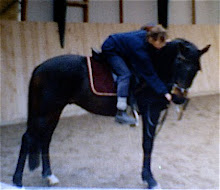
"Are you riding yet, or are you still rolling?"
I found this at Wu Wei Verlag's website, a German publisher specializing in, among other things, publications critical of our culture's increasing violence and abusiveness in the field of equitation, which especially the "Rollkur" *) - which means forcing the horse to bend his neck to a point where his nose almost touches his chest, an unnatural position and extremely damaging especially to the horse's upper vertebrae (though in a broader sense damaging to his entire body and soul) - is an expression of.

The text says: "Are you riding yet, or are you still rolling?" It reminded me of what one of my trainers used to say, that the motto of dressage competitions should be "Look what I'm NOT able of!"
Any parallels to the mh system? Well, if you ask me, the whole mh system is an expression of what its professionals are NOT able of, and one could ask them: "Are you helping people yet, or are you still oppressing them?"
Via Camera-Obscura
_______________
*)The English term is hyperflexion.

The text says: "Are you riding yet, or are you still rolling?" It reminded me of what one of my trainers used to say, that the motto of dressage competitions should be "Look what I'm NOT able of!"
Any parallels to the mh system? Well, if you ask me, the whole mh system is an expression of what its professionals are NOT able of, and one could ask them: "Are you helping people yet, or are you still oppressing them?"
Via Camera-Obscura
_______________
*)The English term is hyperflexion.
Wednesday, 7 April 2010
The latest in psych ward design from the Architectural Digest
Need new furniture for your bedroom? This bed isn't only maintenance-free, but, according to the manufacturer, also a real delight to the eye, or, well, "visually appealing" at least. Watch the straight lines and clearly defined colors. Indeed, neo-minimalistic aesthetics at its best!
Via Liz Spikol.
...and for some reason the Comfy Chair comes to mind:
Via Liz Spikol.
...and for some reason the Comfy Chair comes to mind:
Wednesday, 24 February 2010
Let's have it anyway, shall we: Some bipolar-Stan-Grof-Ken-Wilber-élitism with Sean Blackwell from Bipolar Or Waking Up?
I wrote a post about the matter back in January. I took it down because Sean contacted me, and said I'd got it all wrong. Since then, a few e-mails have been sent to and fro, in order to, hopefully, get it all right.
It all started when I came across the comments at Sean's vid about "hallucinations", and got, frankly, pissed off about a reply by Sean to a comment by someone, "abbeyism", who's more or less completely bought into the mainstream "the crazy pick axe killer"-fear mongering: "Oh my God, I hope no seriously ill people hear this, go off their much needed medication for glossier grandiose religious awakenings and become dangerous...again," "abbeyism" wrote.
Well well, we all know that this kind of reasoning, unfortunately, is wide-spread among people, who have no clue what crisis is about but what they've been told by mainstream psychiatry through the mainstream media. So, what I reacted to wasn't that much this comment, although I also left a reply to "abbeyism" at the thread, but, as mentioned, Sean's reply to "abbeyism": "(...) On my previous video on paranoia, I said that in many cases, paranoid people will be better off medicated. (...)" - Btw, I also questioned his viewpoint in the comment thread to his vid on "paranoia".
This is what I wrote in reply to Sean:
An outstanding example of what I call the bipolar-Stan-Grof-Ken-Wilber-élitism. Us and them. The real loonies, and us, the chosen ones.
I think a quite realistic estimation is that about 70 - 80 % (if not more) of ppl labelled "sz" experiences "paranoia". If it were true, that most of them are better off medicated, widely drug-free alternatives like Soteria or Finnish Open Dialog wouldn't have the success they DO have.
Neither would long-term outcome studies time and again suggest, that recovery from "sz" off drugs is far more likely than on them. The truth is, hardly anyone on drugs ever fully recovers. The majority of ppl OFF them does.
John Nash didn't recover and return to Princeton bc he popped the poison, A Beautiful Mind wants us to believe, he popped. He recovered bc he tossed the poison out, and never touched it after 1970. If anyone, HE was "paranoid".
I really love your vids, Sean, but do me a favor, and read up on the science!
In contrast to my reply to "abbeyism", it took some time before this comment was approved of. Maybe Sean wanted to put together an answer to my comment before he put it out there. Fair enough.
Now, in our e-mail exchange Sean said he didn't regard neither himself nor Grof nor Wilber "enlightened", and that it certainly wasn't his intention to discriminate against anyone. I told him, I'd edit my post, and probably also change its title. I won't do the latter though, because élitism is, unfortunately, still what I see is going on here. Pure New Age élitism. As in, for instance, if you suffer from "paranoia" and other distressing experiences during crisis, that may well be a manifestation of the negative, "dark" energies, you're born with. Bad karma, exactly as in bad, "faulty", genes. In other words, if you've suffered severe abuse and neglect during childhood, it's probably because you've been an asshole in a past life. Your own fault, and now you pay for it. Oh, really?? The New Age way of letting the abusers off the hook, and maintain the status quo. Sorry, I don't buy it. And I'd like to see Sean tell this all those many kids who are abused and neglected by their parents and/or other people in their lives to their face: "You know, according to our philosophy, you only get what you deserve. Probably it's because you're a little stupid, spiritually slightly retarded, that you need to go through this. So, stop whining, and get on with your life." Well well well, if this is regarded "awakened", I certainly can do without any awakening.
Anyhow, still in a conciliatory mood, I yesterday ventured to watch Sean's latest vids, "Spiritual Awakening vs. Bipolar Disorder" Part One, Part Two, and Part Three. If nothing else, watch the third part, and pay attention to what Sean says from 09.33 in the vid on, which, as I let Sean know, in my interpretation translates into: "schizophrenics" are less likely to recover than people labelled "bipolar" by psychiatry. Sean did not object to my interpretation.
IMHO, it is utterly snobbish and, indeed, discriminating to tell people, well in fact that they're too stupid, too spiritually retarded to recover, and maybe even turn their experience of profound suffering into personal growth and development, and that they therefor are better off drugged into a stupor. Not to mention that it is plain nonsense, both in the light of the scientific literature, and in that of innumerable personal accounts. As a matter of fact, the more suffering, the more likely recovery becomes. Since suffering acts as an incentive for transformation. It may very well be that, as I wrote to Sean, "[p]eople who've experienced a lot of trauma in their lives from a very early age on probably need more time to work it all out. Indeed, "mania" usually lasts for about a fortnight, on average, doesn't it, "psychosis" for about five to six weeks, which could be seen as correlating with the amount and intensity of trauma the person has experienced. But from there to conclude that people who maybe need more intense support for maybe some longer time than others are less likely to recover..." actually strikes me as some of the worst New-Age-us-and-them-élitism I've ever witnessed, and certainly not as awakened.
Bottom line: Sean's vids are absolutely worth watching. They definitely contributed to my own understanding of my experience. But beware of their dividing holier-than-thou-attitude towards "the schizophrenics", especially those labelled "paranoid".
If you read this, Sean, you'll probably feel deeply injured. You're welcome to comment and tell me that you didn't intend to say that "the schizophrenics", no matter how "paranoid" btw, are less likely to recover than those who received a fancy "bipolar" label from their shrink.
_______________
P.S.: If you remember the original post: the person who got turned down by Grof because of his/her label, that wasn't Sean, no. My mistake. Anyhow, it happened, and it tells something about the great guru's attitude towards people who carry the "wrong" label. The person in question was labelled "schizophrenic"...
_______________
For comments on the original post see here
It all started when I came across the comments at Sean's vid about "hallucinations", and got, frankly, pissed off about a reply by Sean to a comment by someone, "abbeyism", who's more or less completely bought into the mainstream "the crazy pick axe killer"-fear mongering: "Oh my God, I hope no seriously ill people hear this, go off their much needed medication for glossier grandiose religious awakenings and become dangerous...again," "abbeyism" wrote.
Well well, we all know that this kind of reasoning, unfortunately, is wide-spread among people, who have no clue what crisis is about but what they've been told by mainstream psychiatry through the mainstream media. So, what I reacted to wasn't that much this comment, although I also left a reply to "abbeyism" at the thread, but, as mentioned, Sean's reply to "abbeyism": "(...) On my previous video on paranoia, I said that in many cases, paranoid people will be better off medicated. (...)" - Btw, I also questioned his viewpoint in the comment thread to his vid on "paranoia".
This is what I wrote in reply to Sean:
An outstanding example of what I call the bipolar-Stan-Grof-Ken-Wilber-élitism. Us and them. The real loonies, and us, the chosen ones.
I think a quite realistic estimation is that about 70 - 80 % (if not more) of ppl labelled "sz" experiences "paranoia". If it were true, that most of them are better off medicated, widely drug-free alternatives like Soteria or Finnish Open Dialog wouldn't have the success they DO have.
Neither would long-term outcome studies time and again suggest, that recovery from "sz" off drugs is far more likely than on them. The truth is, hardly anyone on drugs ever fully recovers. The majority of ppl OFF them does.
John Nash didn't recover and return to Princeton bc he popped the poison, A Beautiful Mind wants us to believe, he popped. He recovered bc he tossed the poison out, and never touched it after 1970. If anyone, HE was "paranoid".
I really love your vids, Sean, but do me a favor, and read up on the science!
In contrast to my reply to "abbeyism", it took some time before this comment was approved of. Maybe Sean wanted to put together an answer to my comment before he put it out there. Fair enough.
Now, in our e-mail exchange Sean said he didn't regard neither himself nor Grof nor Wilber "enlightened", and that it certainly wasn't his intention to discriminate against anyone. I told him, I'd edit my post, and probably also change its title. I won't do the latter though, because élitism is, unfortunately, still what I see is going on here. Pure New Age élitism. As in, for instance, if you suffer from "paranoia" and other distressing experiences during crisis, that may well be a manifestation of the negative, "dark" energies, you're born with. Bad karma, exactly as in bad, "faulty", genes. In other words, if you've suffered severe abuse and neglect during childhood, it's probably because you've been an asshole in a past life. Your own fault, and now you pay for it. Oh, really?? The New Age way of letting the abusers off the hook, and maintain the status quo. Sorry, I don't buy it. And I'd like to see Sean tell this all those many kids who are abused and neglected by their parents and/or other people in their lives to their face: "You know, according to our philosophy, you only get what you deserve. Probably it's because you're a little stupid, spiritually slightly retarded, that you need to go through this. So, stop whining, and get on with your life." Well well well, if this is regarded "awakened", I certainly can do without any awakening.
Anyhow, still in a conciliatory mood, I yesterday ventured to watch Sean's latest vids, "Spiritual Awakening vs. Bipolar Disorder" Part One, Part Two, and Part Three. If nothing else, watch the third part, and pay attention to what Sean says from 09.33 in the vid on, which, as I let Sean know, in my interpretation translates into: "schizophrenics" are less likely to recover than people labelled "bipolar" by psychiatry. Sean did not object to my interpretation.
IMHO, it is utterly snobbish and, indeed, discriminating to tell people, well in fact that they're too stupid, too spiritually retarded to recover, and maybe even turn their experience of profound suffering into personal growth and development, and that they therefor are better off drugged into a stupor. Not to mention that it is plain nonsense, both in the light of the scientific literature, and in that of innumerable personal accounts. As a matter of fact, the more suffering, the more likely recovery becomes. Since suffering acts as an incentive for transformation. It may very well be that, as I wrote to Sean, "[p]eople who've experienced a lot of trauma in their lives from a very early age on probably need more time to work it all out. Indeed, "mania" usually lasts for about a fortnight, on average, doesn't it, "psychosis" for about five to six weeks, which could be seen as correlating with the amount and intensity of trauma the person has experienced. But from there to conclude that people who maybe need more intense support for maybe some longer time than others are less likely to recover..." actually strikes me as some of the worst New-Age-us-and-them-élitism I've ever witnessed, and certainly not as awakened.
Bottom line: Sean's vids are absolutely worth watching. They definitely contributed to my own understanding of my experience. But beware of their dividing holier-than-thou-attitude towards "the schizophrenics", especially those labelled "paranoid".
If you read this, Sean, you'll probably feel deeply injured. You're welcome to comment and tell me that you didn't intend to say that "the schizophrenics", no matter how "paranoid" btw, are less likely to recover than those who received a fancy "bipolar" label from their shrink.
_______________
P.S.: If you remember the original post: the person who got turned down by Grof because of his/her label, that wasn't Sean, no. My mistake. Anyhow, it happened, and it tells something about the great guru's attitude towards people who carry the "wrong" label. The person in question was labelled "schizophrenic"...
_______________
For comments on the original post see here
Monday, 4 January 2010
Open Dialogue - A critique in reply to Will Hall
Will Hall posted a piece on Open Dialogue - or Dialog as it spells in American English - at Beyond Meds today.
He writes that "[i]n discussions about open dialog, some have objected to inclusion of family members in the dialog process." One of these "some" am I. A couple of months ago, I posted my part of an extensive e-mail exchange with a friend here in Denmark who's made a couple of videos about the implementation of Open Dialogue elements some places in Danish psychiatry, on Facebook. So, if you're a Facebook-friend of mine, you can find it there in my notes. For everybody else, I will repost here in a slightly edited (I've no intentions to feed the Fullofits out there any arguments in favor of their agenda) version.
Will writes in his piece at Beyond Meds that he is "leaning towards championing open dialog alongside soteria as a viable model we all should learn from." Here is, in short, why I for one lean towards championing Soteria above Open Dialogue (for those of you who want the long and detailed version of my criticism, see my part of the e-mail correspondence below):
1. One of the "golden rules" of Open Dialogue is that there is no talking about anyone who isn't present. As far as the person in crisis is concerned, I regard this a matter of course. When it comes to others, like family members, I find it problematic. Especially people in a more or less emotionally vulnerable state of mind may find it difficult to talk about abuses they've experienced, and that probably lead to them being in crisis, with their abuser(s) present. The presence of the abuser(s) may very well make the environment where the dialogue takes place a lot less safe than it could and should be. Trying to persuade - or even coerce - a person in crisis into tolerating the presence of their abuser(s) while the pain the abuser(s) has caused is talked about by making the presence of the abuser(s) a precondition to any talk about them, seems almost abusive to me in itself.
2. In my opinion, a safe place for the person in crisis to stay at is one of the most important ingredients for healing to occur. Open Dialogue does not offer the person in crisis a truly safe place to retreat to, like Soteria does. Open Dialogue's aim is to preferably leave the person in crisis in her environment - which may for instance mean staying under the same roof as her abuser(s) - and doesn't offer anything but hospitalization as an "alternative". Hospitals are not safe places for people in crisis. They are no alternative. Even without medical "treatment" implemented, staying at a hospital makes the person who stays there a patient, pathologizes her. Open Dialogue here contradicts itself, when it is stated that "[w]hat we avoid: Diagnostic procedures; Medication; Control; The language of pathology;..."
3. Last but not least, Open Dialogue defines itself as a different kind of psychiatry, not an alternative to psychiatry. Psychiatry per se is a medical speciality. It is not a branch of sociology, psychology, philosophy, or whatever else along those lines. In the videos my friend has made, one of the "experts" working with Open Dialogue elements explicitly states that the "experts" still would be needed. Open Dialogue or not. My question in this regard is what the "experts" are needed for if not for "Diagnostic procedures; Medication; Control; The language of pathology"?? As far as I know, this is what the "experts'" training is all about. It is not about the sociology of interpersonal relationships, spiritual issues, trauma-related distress, or any of the other components of crisis.
Soteria has shown that there is one qualification that is more important than any ever so advanced, professional training or theoretical "knowledge" - actually, I don't think, there can be any such thing as true knowledge of crisis other than from first hand experience, or, at least, unreserved acceptance of the person in crisis - when it comes to the "staff": the ability to "be with" someone without reservations, without any fear, and no matter where this someone is at in terms of his/her state of mind. Professionalism in the field usually is (ab)used to create a safety distance, a power imbalance, between the person in crisis and the "staff", the support team. (Thus, the Norwegian psychologist Christian Moltu states that therapists have a tendency to hold up therapy techniques as a kind of "shield" between their clients and themselves whenever the client, respectively his/her experience, becomes too threatening to them.) Terms like "patient" and "staff" alone are enough to create this distance, or imbalance. Open Dialogue, at least partly in contrast to Soteria, and contradicting its own above-quoted statement, does make use of this professionalizing, pathologizing and alienating terminology.
Concerning medications, that may be a short-term solution in some cases, it doesn't need an "expert" to prescribe them. Any GP can do the job.
Bottom line: Open Dialogue in my opinion has the potential to become an alternative alongside Soteria. Without doubt. As long as it involves "experts", hospitalization, the language of pathology, as long as it involves, instead of excludes, psychiatry, and as long as it does not offer really safe places for people in crisis to go, though, it is not nearly as acceptable to me as Soteria is.
_______________
Read Will Hall's comment on my reply, "More on Open Dialog", here.
_______________
These are my e-mails ("Vestlaplandsmodellen" is an alternative and widely used in Scandinavia term for Open Dialogue):
1. e-mail: Thanks for the links! I watched both programs - the first though had only about 15 minutes of the program - and they gave me an idea of the situation here in DK, which I'm - as I guess you know - not uncritical of.
[These are the links: TVGaderummet 23.sept.2009 (Danish)
1. http://tvgaderummet.info/Links%20til%20tvg-film/tvg214-abendialog-23sept09-laplandsmodelen-paul36.mpg.avi.wmv.html (60 minutes)
2. http://tvgaderummet.info/Links%20til%20tvg-film/tvg215-81paneldiskusion-23sept09-paul37.wmv.html (60 minutes)]
I'm actually not that much acquainted with the Vestlaplandsmodellen as I am with Soteria. I only know about the former what is available on the net, and that's not a lot. Well, of course it's great that some of the elements of the Vestlaplandsmodellen are employed at least in some few places in DK. Nevertheless, what strikes me watching the vids is, that, Vestlaplandsmodellen or not, people in crisis are still referred to as "patients" - I'm not very patient, and I never was :D - and the self-appointed "experts" are still referred to as experts. I'm a lot more radical than that. At one point there's someone who asks when there will be a shift in the power imbalance between "patient" and staff in the mh system. IMO it won't happen as long as "patients" are "patients", and "experts" are "experts". Open dialogue or not. The "experts" need to go. That is, the medical profession needs to go. In spite of a whole lot of talk about humility - very nice, indeed! - the "experts" still don't admit, that their "expertise" as members of the medical profession isn't of much use to people in crisis. Actually, at one point one of them explicitly states, that they are still needed. They are not. Unless of course, we keep on employing the medical model to one or another extent, and I don't know where the Vestlaplandsmodellen stands in that regard.
I had a quick look at Region Syddanmark's site: http://www.regionsyddanmark.dk/wm232390, and alone the "Ikke et enten-eller - men et både-og" (not an either-or but a both-and; meaning treatment options) somehow gives me the creeps. Another thing that gives me the creeps, time and again, and thus in the vids too, is the incessant yattering about how important it is to involve the relatives. Network yes, relatives rarely. Usually the person in crisis' relatives are their primary traumatizers - does the Vestlaplandsmodellen acknowledge this? Does it acknowledge the trauma-model at all? And if so, in how far? -, and I agree wholeheartedly with those, who rather want people in crisis to realize this, and distance themselves, actually break away, from their toxic relatives, than to try and "salvage" family ties at any cost. IMO acknowledging the trauma is extremely important, not only in an mh-context, but in regard to our culture on the whole.
What also strikes me, once again, is the politicians' ability to talk at length without saying much substantial. An awful lot of hot air... Well, and I wonder how anyone still can be the least in doubt about the efficiency of non-medical approaches to crisis. After I don't know how many years of success with alternatives, be it the Vestlaplandsmodellen, Soteria, or whatever of that kind.
2. e-mail: A while ago, I listened to some Norwegian radio broadcast by a psychologist, Grethe Nordhelle, about manipulation. She concluded, that only consciously deceiving people is true manipulation. I sent her an e-mail where I wrote how I'd experienced my mother to have been extremely manipulative, but nevertheless not in a fully conscious fashion. She replied, that there was a grey zone of helplessness, where the deceiver/manipulator is conscious about what s/he is doing, but since his/her ego's survival depends on doing it, s/he suppresses the awareness of his/her actions hurting others. It's the narcissist's way of surviving. And they haven't got any other way. - And I use the term "narcissist" acknowledging that we're all more or less "narcissists" in as far as we (almost) all have an ego that likes to take control. Which, if allowed, results in us needing and (ab-)using others for our own ego's benefit. What I mean by the term in this context is people, who are more or less completely identified with their ego, and thus unaware that they are not their ego. So, whatever these people do comes from the place of their ego. And the ego doesn't love or care for anything but itself.
The majority of society's helpers, especially in the mh system, are such narcissists. They're attracted to the helping professions because these are the professions where one can feel most needed, and successful at the same time, compared to the patient's/client's misery - as long as the patient/client remains miserable... The mh system is every narcissist's paradise, because it's about the only among the helping professions where one can get away with actively preventing people from recovering and becoming independent of the narcissist's help. In addition, no human being is as helpless and dependent as someone whom you can declare " insane" whenever you, the "expert", like, someone who, due to a brain disease, is not able to make any decisions on their own, and thus need the "expert" to run their life.
The point is, they know what they're doing. They know, they're deceiving, exploiting, manipulating, and actually harming others for their own benefit, but they suppress this knowledge, and make an effort to convince both themselves and everybody else of their actions to be necessary and even beneficial for their victims, because they're nothing, absolutely nothing, without or beyond their ego. That they act out of fear and helplessness doesn't excuse their actions. They're fully responsible. Just as a psychopath is fully responsible if s/he commits a crime. Or just like the oil industry is fully responsible for the environmental damage it causes, although it needs to cause this damage in order to survive.
You would have to enlighten these people to make them stop constantly looking for new objects ("patients") they can project their own profound insecurity and helplessness into. But enlightenment doesn't happen from without. It can only happen from within the person herself. And it only happens when there's enough suffering, which in the case of the narcissist means, that they can't find an object to satisfy their insatiable (!) need to be needed with.
The "revolution" has to start with the "patients" shedding the label of "patient", the identification as the helpless victim. Difficult. Very difficult. Especially when it comes to people in emotional distress, that more often than not is the result of never having been anything else but helpless victims. People who've been traumatized tend to repeat the trauma. Over and over again. Being the victim is the only way they know to survive. A perfect match for the narcissist. And gene-theories, biological determinism, if it's in regard to "mental illness", criminal, or whatever else kind of "abnormal" behavior, is the ultimate victimization. Designed by a thoroughly narcissistic culture to serve its narcissist-members' needs.
IMO, no one, neither the victim nor the perpetrator, is served by excusing the abuse, saying the perpetrator-abuser didn't know what s/he was doing. As long as we keep on and are afraid of blaming - i.e. holding accountable - the perpetrators, they will keep on abusing us. Nothing much will change. Anger can also be a good thing. I've tried not to be angry. I've tried to make myself believe the "they don't know what they do"-thing. Something inside me gets very very angry each time I try. Because it just isn't true, that they don't know, and therefor should be forgiven. I want to hold them fully accountable. That is what I can do by now without anger. It's not about revenge. I don't care if they pay for what they've done. The past doesn't interest me. It's about the truth to be said, and stop the abuse from continuing forever.
Long rant, one more thing: How does the Vestlaplandsmodellen handle situations where the abuser/relative is either dead or doesn't want to participate? The latter is a problem that I know both Bateson, Arbours Crisis Centre and similar approaches more often than not had/have. Even people, who initially agreed to participate, left offended and under protest at the slightest suggestion that they maybe were just a little responsible. Narcissists don't make mistakes. It's always everyone else's fault but theirs if anything goes wrong. Suggesting something else usually sends them right through the roof. Exactly because they know, they're to blame. And they rarely at all agree to participate in anything where they risk to be blamed. So, what does the Vestlaplandsmodellen do about that? Forgiveness? No blame?
I see some good things happening, me too. Things like the hearing voices network getting more and more attention, or like Daniel Mackler's film. I'm still a bit suspicious toward the Vestlaplandsmodellen. IMO, it's not both-and. It definitely is either-or. Whatever biological/genetic differences, they are symptoms - of abuse -, not causes.
Hope, I don't come off too harsh. It's just that it really gets me to watch these people get away with their actions again and again and again, because we can't let go of being the victim and feeling guilty about speaking the truth.
3. e-mail: Another rant:
We're all responsible. For ourselves as well as for the community. Not ever holding anyone accountable for their actions equals to telling them it's ok to act irresponsible. If no one ever is going to be held accountable, nothing will change. The world, humanity, is in the mess it is today, because no one is willing to take responsibility, and because no one is willing to ask others to take responsibility, because that then would mean they'd have to take it themselves.
I'm sorry, my parents were responsible. They screwed up. They did as good as they could, but that doesn't change the fact, that it wasn't good enough. Taking responsibility means accepting that fact. Without acceptance no change. BUT: my parents' responsibility also ends where my own starts. "Mental illness" is not being given the opportunity to know. Today I know. So, I can't be "mentally ill" anymore without being responsible for it myself. It's my own choice, and so it will be my own fault, if ever I suffer in the irresponsible way of "mental illness" again.
I'm an existentialist, yup.
"It's ok to make mistakes. But it's unforgivable to make a mistake, and then claim it to have been the right thing to do, while you know, it was a mistake." (Ewa Jälmbrant)
Something else: Hammersley and Read: about 70 % of all people labelled "sz" have been abused physically and/or sexually during childhood. Add to that psychological/emotional abuse/neglect and get 100 %. I think it is obscene to expect a 17-year-old to sit in the same room with her father and talk about having been repeatedly raped by him from an age of, let's say, five or six years old, while the fact that she was so, and that she can't talk about it, rendered her "psychotic". What do we do? Forgive and forget without ever really talking about it? Won't work, I fear. Not in the long run.
In this context: shame - people feel shame because they were/are victims of abuse and are asked to keep silent about it: "It's your fault. You made me do this to you. So, don't blame me." And so they continue their business, the abusers.
If they just do what they're trained to do, unconsciously, irresponsibly, how come there are quite a lot who leave the system, disgusted by it, because they, in spite of all training, are able to see its harmfulness? How come, Loren Mosher was able to see, but not Merete Nordentoft? The scientific evidence is there, for all to see. They know it. They CHOOSE to ignore it.
4. e-mail: I don't want to fight them. I know, that it only would/will make them strike back even harder. - And that's actually what I see also is going on today, as alternatives, like for instance the hearing voices network, get more and more attention, and as there are more and more research findings that question the biological model. They feel threatened and strike back harder: assisted outpatient treatment, Thomas Werge's eugenic "research", re-establishment of padded "quiet rooms", i.e. isolation, etc. - And I absolutely agree to your point concerning primal therapy and the like.
But, on the other hand, when I have a problem, and ignoring, suppressing it makes me sick, I need to come to terms with it. Consciously. Even if that means, that I have to blame someone. - And although the term "blame" has a somewhat negative connotation, it only means "holding accountable". It doesn't mean "attack", "fight". Why does our culture regard holding someone accountable as a negative thing?... - So, basically, what it means is that I express what someone else's actions do or have done to me. Then, it is up to that someone whether they want to take my words as a personal attack - and a narcissist will do so - or whether they take them simply as feedback, allowing them to reflect their actions - which is what a responsible person does.
My responsibility is to separate my emotions from my words, and not to call someone names, for instance. Which IS a personal attack. Of course. That doesn't mean that I may not tell someone, that their actions made or make me feel angry. Or sad, or confused, "psychotic", "schizophrenic", "manic", "depressed", or whatever. If I'm not allowed to tell them, they'll carry on with their destructiveness, their abuse, and nothing is ever going to challenge the delusion of their own infallibility they've constructed for themselves and everybody else. If I'm not allowed to tell them, what we've got is exactly Laing's "Don't" again. Back to square one. The elephant in the living room, no one is allowed to see. And then my unconscious, seeing the elephant, doesn't leave me any other option than to resort to its own language: "insanity". The way to enlightenment goes through suffering - feeling and acknowledging, accepting, the emotions that were suppressed or denied. If I don't allow myself to experience that step, I won't get to the next.
http://www.youtube.com/watch?v=KorhMAsE3nU
http://www.youtube.com/watch?v=pwCUzV3izAI
And, btw, that's exactly what psych drugs are designed to do. Preventing people from recognizing the truth by throwing them back into a state of dissociation. It's not a historical mistake. From the ego's point of view it's the only right thing to do. If the self becomes conscious, the ego is no longer in control. Our culture is a culture of the ego. It's not a mistake. It's premeditated, and it serves a purpose.
I doubt, they feel compassion. Maybe they tell themselves, and everybody else, that it's compassion, but narcissists don't feel compassion, or have empathy. What they feel writing prescriptions is a momentary satisfaction of their ego's need to be needed.
5. e-mail: I see one advantage in having family involved to the extent that they need to be present when they're talked about: I would have loooved to tell my dear mother in detail, without her interrupting me a dozen times, telling me how terribly wrong I am to feel that way, and completely matter-of-fact, no emotions taking over, how her actions had influenced me, i.e. had messed me up. BUT: 1. I wouldn't have been able to stand as much as the sight of her during the first three or four months (at least). (...) Alone mentioning her made "symptoms" intensify remarkably. My no.1 trigger. (...) IMO, it was crucial, that I had the opportunity to talk about my relationship with her without her being present. 2. It would have taken me one single session to tell her the above mentioned stuff. I dare say, I know what her reaction would have been... And no matter how gentle, calm, reasonable, whatever, I'd worded it. With the best will of the world I can't see why anyone would want to, at any cost, salvage a "relationship" like the one I had with my mother. One thing's for sure: I would have been the one, who'd paid for that.
Of course everybody, even someone like my mother, deserves a chance. However, my mother would have blown that chance, no doubt. And then? Then I wouldn't have been given the opportunity to talk about my no.1 trigger? That really pisses me off. Who's side are these guys on? (side: Yes, our "relationship" basically was that of enemies. It was war. But it wasn't me, who'd made her my enemy.)
More bitching: Somehow this no talking about anyone who isn't present to me smells a bit of blackmail. Quite similar to "Take your meds, or we won't pay for therapy (or even worse: we'll withdraw your SSI)." - It's illegal, nevertheless it happens. And often enough they get away with it, because people don't know their rights. The no meds no therapy-thing for instance, my therapist told me about a client of hers who'd been threatened with it. - Make that: "If you don't agree to meet your family/parents, we can't help you." And then what? The back ward? I see why they focus on young people, first "episode" - BTW: http://www.miwatch.org/2009/10/upcoming_conference_focuses_on.html#comments. People in their late teens or early twenties usually are somewhat more easy to "influence", oh well, threaten, than a thirty- or forty-year-old. Drugs or not, if it really is categorically enFORCEd (like in "coercion", yup) that you have to communicate with your abuser(s), or you won't get help, these people aren't much better than the abuser(s) themselves. What people in crisis need is UNconditional support and accept. Not more and even more of the emotional blackmail, that got them into crisis in the first place.
Geez, I would like a word with this Jaakko! :D
Ask people what was helpful during crisis and recovery. More often than not they'll mention time away from their family/parents, among the most important things.
It's really nice that they don't use more drugs than they do. Still, Soteria seems a lot more attractive and desirable - and, indeed, the person in crisis respecting - to me.
6. e-mail: "Certainly, when meeting with people who are acutely mentally ill and those who love them, we can feel compassion for their determination to stick to the predictability of monologic positions." (from the article) [http://findarticles.com/p/articles/mi_qa3658/is_200207/ai_n9086188/]
Well, I stick to my positions: 1. I was not "mentally ill", period. (cf. Pernille in the vid stating she was ill. What did she suffer from? The flu?... Sorry for the sarcasm, it just really bugs me.)
2. My mother didn't love me. (As devastating as it was at first, it was one of the most important insights to reach. "I Never Promised You a Rose Garden" - the title was chosen for a reason.)
3. No one, not wild horses, and not even Jaakko Seikkula himself, would have been able to make my mother engage in a dialogue, unless she'd been guaranteed in advance, that she wouldn't have to accept any criticism of her person, and that it would be all about me being the one (and only) to blame.
The philosophy I see Open Dialogue employ - and I may be wrong, but so far it's my strong impression - is the usual, so to speak: It's the person in crisis, something's wrong with, she's the "patient", the "mentally ill" individual. Pernille for instance says at one point in the first vid: "...ud fra det, der fejlede mig..." (...on the basis of what was wrong with me...) So, something was wrong with her? I don't agree. At least, nothing more was wrong with her than what was wrong with everybody else... But of course, SHE got singled out, the spotted mental patient, because it was HER behavior that didn't fit the cultural norm... It isn't as pronounced as in conventional settings, still it's there. Why on earth can't we just get rid of this patronizing, devaluing (even if it's to a somewhat lesser extent in Open Dialogue) language entirely?? Makes me feel sick (haha...).
A little more respect for the person in crisis isn't enough. She has to be respected fully. It's not both-and. It's either-or. Or: you can't have your cake and eat it. You can't define someone as "mentally ill" and at the same time claim to respect them. You can't hold on to being the needed "expert", and at the same time claim to see the person, not the diagnosis. It's scary for someone who identifies as "expert", "mentally ill" or just "formerly mentally ill" to imagine having to let go of that identification. But it's the only way. IMHO.
"Psychiatry" by definition is a medical speciality. Open Dialogue defines itself, as far as I have understood, as a slightly different kind of psychiatry. As a medical speciality psychiatry pathologizes people's thought processes, emotions and behavior (if it didn't pathologize it wouldn't be a medical speciality, psychiatrists wouldn't be required to have studied medicine to enter the field; at some point Karen Klindt uses the term "klinisk psykiatri" (clinical psychiatry) in the first vid; "klinisk psykiatri" is a tautology; practised psychiatry is by definition clinical). That is, people in crisis' thought processes, emotions and behavior are not respected fully. Emphasis on "fully". To achieve that people in crisis are respected fully, psychiatry has to vanish from the surface of this planet. Psychiatry is an anti-democratic, totalitarian entity. It is symptomatic of our anti-democratic society (have a look at http://www.dendemokratiskeskole.dk/ or http://www.summerhillschool.co.uk/ and compare them to Folkeskolen (the Danish primary school), or any other official school system in any other "democracy"; it's everywhere, in every single one of society's institutions, the totalitarianism, more or less; in psychiatry it is pure). It has always been, it will always be.
And again: why on earth is the idea that there may be parents who do not love their kids sooo unacceptable?? It's a reality, for chrissake! Most people in our culture actually have no clue what love really is. They aren't capable of true love, because they themselves never experienced it. So they don't love their kids, they need them (which is about the opposite of love). Neither do they love themselves, they are in love with themselves. Quite a difference. You can't love anyone else if you don't have selflove. - Well, it's unacceptable because if we accepted it, we'd have to accept the fact, that these people, make that about 90 % of humanity, if not more, altogether are traumatized... by our culture, by modern western civilization. "Don't". Because if we do accept it, it's the end of modern western civilization. And we don't want that, do we??
It was only through the insight that my mother didn't love me, that I came to understand that she couldn't love me - and forgive her. This is different from the usual "forgiveness". It allows the whole process, it allows anger and grief, sorrow,... all that messy stuff, that people are so damn afraid of, they can't for anything in the world accept it in its entirety. Not even Open Dialogue.
Now, I've been highly critical. Don't get me wrong. I appreciate the advantages of Open Dialogue for the individual compared to conventional psychiatry very much. However, IMO Open Dialogue is still somehow stuck in certain very conventional thought patterns that I'd like to see abandoned. Because I regard them to be rather destructive on an overall perspective.
I think what we'd need to survive, humanity as a whole I mean, is a far more radical change of our entire culture than what Open Dialogue represents in the mh field, I'm not too optimistic when it comes to our future as a species. I don't see it happen. Partly also because I see people uncritically cheering for "changes" that aren't really changes, on an overall perspective. Open Dialogue - this is probably as good as it gets. It's not good enough, IMO. It's still limited, by it's conditions for instance: you have to interact with your abusers because this is what we do in modern western civilisation. We have such great compassion with the abusers, we can't do without having the abused forgive the abuser. BS, IMHO.
Open Dialogue is a method. methods are always limited. And limiting. There's a lot of room for improvement if you think beyond the limits of methods. Also of this method, as good as it may be compared to conventional "treatment". People just don't realize. So they cheer, uncritically. And history repeats itself...
What we see is people recovering, becoming independent of the system, able to support themselves, working, well-adjusted contributing to society. Great. Really. But they're well-adjusted contributing to a profoundly sick society... These people grow, yes. Great. Really. But they could grow even more. Far beyond the limits of this profoundly sick society. So that they'd never call themselves "mentally ill", "schizophrenic", past or present, anymore, for instance.
7. e-mail: Of course, like every human being, my mother too had the potential to love. She just couldn't make use of it, and although she never talked much about her own childhood/upbringing, I know enough to know why she wasn't able to give love. I do see her, now. And I do love the part of her, that never was allowed to come into being, so to speak. That doesn't mean, that I would have to, at any cost, keep on interacting with her, the person, the individual, she was, for the rest of my life, just because she happened to be my mother.
And: it was crucial, that I was given the opportunity to talk about her and my relationship with her without her being present at the time. "There is no one size fits all" also applies to Open Dialogue. For some it may be ok to have their abusers present from day one. For me it wasn't. I needed physical distance to be able to, at my own pace, have the courage and explore my emotions towards her, and integrate them.
I disagree, that Open Dialogue is the best. It's good, yes. Much better than those crappy pills. Without the least doubt. And it is, also without doubt, wonderful, awesome, absolutely out of this world, that Open Dialogue elements are integrated into the system some places. But why are we, almost exclusively, focussed on Open Dialogue here in DK, when there are more "open", less systematic, rigid, alternatives out there. Soteria, yes. I don't say that Soteria is perfect. But it offers more room for true respect. It works outside of psychiatry, not inside of it. It's (at least) one step ahead of Open Dialogue. Why? Because it demonstrates that "experts" aren't needed. That all that is needed is being consciously in touch with yourself, being a conscious human being. And it demonstrates that crisis is - being human. It existed. It exists, in Alaska, Bern, Munich. The Weglaufhaus in Berlin works according to Soteria principles. There's a Soteria "movement" in the Netherlands. It's not a mere fantasy. Why not broaden the horizon, skip this Open Dialogue is the only alternative-tunnel vision?
I'd just wish there was just a little more focus on the fact, that Open Dialogue is not the one and only solution. (There is no one and only solution...)
But, well, yes, right now, we're light years from acknowledging that crisis is being human. So, of course, Open Dialogue is/would be a huge step in the right direction.
He writes that "[i]n discussions about open dialog, some have objected to inclusion of family members in the dialog process." One of these "some" am I. A couple of months ago, I posted my part of an extensive e-mail exchange with a friend here in Denmark who's made a couple of videos about the implementation of Open Dialogue elements some places in Danish psychiatry, on Facebook. So, if you're a Facebook-friend of mine, you can find it there in my notes. For everybody else, I will repost here in a slightly edited (I've no intentions to feed the Fullofits out there any arguments in favor of their agenda) version.
Will writes in his piece at Beyond Meds that he is "leaning towards championing open dialog alongside soteria as a viable model we all should learn from." Here is, in short, why I for one lean towards championing Soteria above Open Dialogue (for those of you who want the long and detailed version of my criticism, see my part of the e-mail correspondence below):
1. One of the "golden rules" of Open Dialogue is that there is no talking about anyone who isn't present. As far as the person in crisis is concerned, I regard this a matter of course. When it comes to others, like family members, I find it problematic. Especially people in a more or less emotionally vulnerable state of mind may find it difficult to talk about abuses they've experienced, and that probably lead to them being in crisis, with their abuser(s) present. The presence of the abuser(s) may very well make the environment where the dialogue takes place a lot less safe than it could and should be. Trying to persuade - or even coerce - a person in crisis into tolerating the presence of their abuser(s) while the pain the abuser(s) has caused is talked about by making the presence of the abuser(s) a precondition to any talk about them, seems almost abusive to me in itself.
2. In my opinion, a safe place for the person in crisis to stay at is one of the most important ingredients for healing to occur. Open Dialogue does not offer the person in crisis a truly safe place to retreat to, like Soteria does. Open Dialogue's aim is to preferably leave the person in crisis in her environment - which may for instance mean staying under the same roof as her abuser(s) - and doesn't offer anything but hospitalization as an "alternative". Hospitals are not safe places for people in crisis. They are no alternative. Even without medical "treatment" implemented, staying at a hospital makes the person who stays there a patient, pathologizes her. Open Dialogue here contradicts itself, when it is stated that "[w]hat we avoid: Diagnostic procedures; Medication; Control; The language of pathology;..."
3. Last but not least, Open Dialogue defines itself as a different kind of psychiatry, not an alternative to psychiatry. Psychiatry per se is a medical speciality. It is not a branch of sociology, psychology, philosophy, or whatever else along those lines. In the videos my friend has made, one of the "experts" working with Open Dialogue elements explicitly states that the "experts" still would be needed. Open Dialogue or not. My question in this regard is what the "experts" are needed for if not for "Diagnostic procedures; Medication; Control; The language of pathology"?? As far as I know, this is what the "experts'" training is all about. It is not about the sociology of interpersonal relationships, spiritual issues, trauma-related distress, or any of the other components of crisis.
Soteria has shown that there is one qualification that is more important than any ever so advanced, professional training or theoretical "knowledge" - actually, I don't think, there can be any such thing as true knowledge of crisis other than from first hand experience, or, at least, unreserved acceptance of the person in crisis - when it comes to the "staff": the ability to "be with" someone without reservations, without any fear, and no matter where this someone is at in terms of his/her state of mind. Professionalism in the field usually is (ab)used to create a safety distance, a power imbalance, between the person in crisis and the "staff", the support team. (Thus, the Norwegian psychologist Christian Moltu states that therapists have a tendency to hold up therapy techniques as a kind of "shield" between their clients and themselves whenever the client, respectively his/her experience, becomes too threatening to them.) Terms like "patient" and "staff" alone are enough to create this distance, or imbalance. Open Dialogue, at least partly in contrast to Soteria, and contradicting its own above-quoted statement, does make use of this professionalizing, pathologizing and alienating terminology.
Concerning medications, that may be a short-term solution in some cases, it doesn't need an "expert" to prescribe them. Any GP can do the job.
Bottom line: Open Dialogue in my opinion has the potential to become an alternative alongside Soteria. Without doubt. As long as it involves "experts", hospitalization, the language of pathology, as long as it involves, instead of excludes, psychiatry, and as long as it does not offer really safe places for people in crisis to go, though, it is not nearly as acceptable to me as Soteria is.
_______________
Read Will Hall's comment on my reply, "More on Open Dialog", here.
_______________
These are my e-mails ("Vestlaplandsmodellen" is an alternative and widely used in Scandinavia term for Open Dialogue):
1. e-mail: Thanks for the links! I watched both programs - the first though had only about 15 minutes of the program - and they gave me an idea of the situation here in DK, which I'm - as I guess you know - not uncritical of.
[These are the links: TVGaderummet 23.sept.2009 (Danish)
1. http://tvgaderummet.info/Links%20til%20tvg-film/tvg214-abendialog-23sept09-laplandsmodelen-paul36.mpg.avi.wmv.html (60 minutes)
2. http://tvgaderummet.info/Links%20til%20tvg-film/tvg215-81paneldiskusion-23sept09-paul37.wmv.html (60 minutes)]
I'm actually not that much acquainted with the Vestlaplandsmodellen as I am with Soteria. I only know about the former what is available on the net, and that's not a lot. Well, of course it's great that some of the elements of the Vestlaplandsmodellen are employed at least in some few places in DK. Nevertheless, what strikes me watching the vids is, that, Vestlaplandsmodellen or not, people in crisis are still referred to as "patients" - I'm not very patient, and I never was :D - and the self-appointed "experts" are still referred to as experts. I'm a lot more radical than that. At one point there's someone who asks when there will be a shift in the power imbalance between "patient" and staff in the mh system. IMO it won't happen as long as "patients" are "patients", and "experts" are "experts". Open dialogue or not. The "experts" need to go. That is, the medical profession needs to go. In spite of a whole lot of talk about humility - very nice, indeed! - the "experts" still don't admit, that their "expertise" as members of the medical profession isn't of much use to people in crisis. Actually, at one point one of them explicitly states, that they are still needed. They are not. Unless of course, we keep on employing the medical model to one or another extent, and I don't know where the Vestlaplandsmodellen stands in that regard.
I had a quick look at Region Syddanmark's site: http://www.regionsyddanmark.dk/wm232390, and alone the "Ikke et enten-eller - men et både-og" (not an either-or but a both-and; meaning treatment options) somehow gives me the creeps. Another thing that gives me the creeps, time and again, and thus in the vids too, is the incessant yattering about how important it is to involve the relatives. Network yes, relatives rarely. Usually the person in crisis' relatives are their primary traumatizers - does the Vestlaplandsmodellen acknowledge this? Does it acknowledge the trauma-model at all? And if so, in how far? -, and I agree wholeheartedly with those, who rather want people in crisis to realize this, and distance themselves, actually break away, from their toxic relatives, than to try and "salvage" family ties at any cost. IMO acknowledging the trauma is extremely important, not only in an mh-context, but in regard to our culture on the whole.
What also strikes me, once again, is the politicians' ability to talk at length without saying much substantial. An awful lot of hot air... Well, and I wonder how anyone still can be the least in doubt about the efficiency of non-medical approaches to crisis. After I don't know how many years of success with alternatives, be it the Vestlaplandsmodellen, Soteria, or whatever of that kind.
2. e-mail: A while ago, I listened to some Norwegian radio broadcast by a psychologist, Grethe Nordhelle, about manipulation. She concluded, that only consciously deceiving people is true manipulation. I sent her an e-mail where I wrote how I'd experienced my mother to have been extremely manipulative, but nevertheless not in a fully conscious fashion. She replied, that there was a grey zone of helplessness, where the deceiver/manipulator is conscious about what s/he is doing, but since his/her ego's survival depends on doing it, s/he suppresses the awareness of his/her actions hurting others. It's the narcissist's way of surviving. And they haven't got any other way. - And I use the term "narcissist" acknowledging that we're all more or less "narcissists" in as far as we (almost) all have an ego that likes to take control. Which, if allowed, results in us needing and (ab-)using others for our own ego's benefit. What I mean by the term in this context is people, who are more or less completely identified with their ego, and thus unaware that they are not their ego. So, whatever these people do comes from the place of their ego. And the ego doesn't love or care for anything but itself.
The majority of society's helpers, especially in the mh system, are such narcissists. They're attracted to the helping professions because these are the professions where one can feel most needed, and successful at the same time, compared to the patient's/client's misery - as long as the patient/client remains miserable... The mh system is every narcissist's paradise, because it's about the only among the helping professions where one can get away with actively preventing people from recovering and becoming independent of the narcissist's help. In addition, no human being is as helpless and dependent as someone whom you can declare " insane" whenever you, the "expert", like, someone who, due to a brain disease, is not able to make any decisions on their own, and thus need the "expert" to run their life.
The point is, they know what they're doing. They know, they're deceiving, exploiting, manipulating, and actually harming others for their own benefit, but they suppress this knowledge, and make an effort to convince both themselves and everybody else of their actions to be necessary and even beneficial for their victims, because they're nothing, absolutely nothing, without or beyond their ego. That they act out of fear and helplessness doesn't excuse their actions. They're fully responsible. Just as a psychopath is fully responsible if s/he commits a crime. Or just like the oil industry is fully responsible for the environmental damage it causes, although it needs to cause this damage in order to survive.
You would have to enlighten these people to make them stop constantly looking for new objects ("patients") they can project their own profound insecurity and helplessness into. But enlightenment doesn't happen from without. It can only happen from within the person herself. And it only happens when there's enough suffering, which in the case of the narcissist means, that they can't find an object to satisfy their insatiable (!) need to be needed with.
The "revolution" has to start with the "patients" shedding the label of "patient", the identification as the helpless victim. Difficult. Very difficult. Especially when it comes to people in emotional distress, that more often than not is the result of never having been anything else but helpless victims. People who've been traumatized tend to repeat the trauma. Over and over again. Being the victim is the only way they know to survive. A perfect match for the narcissist. And gene-theories, biological determinism, if it's in regard to "mental illness", criminal, or whatever else kind of "abnormal" behavior, is the ultimate victimization. Designed by a thoroughly narcissistic culture to serve its narcissist-members' needs.
IMO, no one, neither the victim nor the perpetrator, is served by excusing the abuse, saying the perpetrator-abuser didn't know what s/he was doing. As long as we keep on and are afraid of blaming - i.e. holding accountable - the perpetrators, they will keep on abusing us. Nothing much will change. Anger can also be a good thing. I've tried not to be angry. I've tried to make myself believe the "they don't know what they do"-thing. Something inside me gets very very angry each time I try. Because it just isn't true, that they don't know, and therefor should be forgiven. I want to hold them fully accountable. That is what I can do by now without anger. It's not about revenge. I don't care if they pay for what they've done. The past doesn't interest me. It's about the truth to be said, and stop the abuse from continuing forever.
Long rant, one more thing: How does the Vestlaplandsmodellen handle situations where the abuser/relative is either dead or doesn't want to participate? The latter is a problem that I know both Bateson, Arbours Crisis Centre and similar approaches more often than not had/have. Even people, who initially agreed to participate, left offended and under protest at the slightest suggestion that they maybe were just a little responsible. Narcissists don't make mistakes. It's always everyone else's fault but theirs if anything goes wrong. Suggesting something else usually sends them right through the roof. Exactly because they know, they're to blame. And they rarely at all agree to participate in anything where they risk to be blamed. So, what does the Vestlaplandsmodellen do about that? Forgiveness? No blame?
I see some good things happening, me too. Things like the hearing voices network getting more and more attention, or like Daniel Mackler's film. I'm still a bit suspicious toward the Vestlaplandsmodellen. IMO, it's not both-and. It definitely is either-or. Whatever biological/genetic differences, they are symptoms - of abuse -, not causes.
Hope, I don't come off too harsh. It's just that it really gets me to watch these people get away with their actions again and again and again, because we can't let go of being the victim and feeling guilty about speaking the truth.
3. e-mail: Another rant:
We're all responsible. For ourselves as well as for the community. Not ever holding anyone accountable for their actions equals to telling them it's ok to act irresponsible. If no one ever is going to be held accountable, nothing will change. The world, humanity, is in the mess it is today, because no one is willing to take responsibility, and because no one is willing to ask others to take responsibility, because that then would mean they'd have to take it themselves.
I'm sorry, my parents were responsible. They screwed up. They did as good as they could, but that doesn't change the fact, that it wasn't good enough. Taking responsibility means accepting that fact. Without acceptance no change. BUT: my parents' responsibility also ends where my own starts. "Mental illness" is not being given the opportunity to know. Today I know. So, I can't be "mentally ill" anymore without being responsible for it myself. It's my own choice, and so it will be my own fault, if ever I suffer in the irresponsible way of "mental illness" again.
I'm an existentialist, yup.
"It's ok to make mistakes. But it's unforgivable to make a mistake, and then claim it to have been the right thing to do, while you know, it was a mistake." (Ewa Jälmbrant)
Something else: Hammersley and Read: about 70 % of all people labelled "sz" have been abused physically and/or sexually during childhood. Add to that psychological/emotional abuse/neglect and get 100 %. I think it is obscene to expect a 17-year-old to sit in the same room with her father and talk about having been repeatedly raped by him from an age of, let's say, five or six years old, while the fact that she was so, and that she can't talk about it, rendered her "psychotic". What do we do? Forgive and forget without ever really talking about it? Won't work, I fear. Not in the long run.
In this context: shame - people feel shame because they were/are victims of abuse and are asked to keep silent about it: "It's your fault. You made me do this to you. So, don't blame me." And so they continue their business, the abusers.
If they just do what they're trained to do, unconsciously, irresponsibly, how come there are quite a lot who leave the system, disgusted by it, because they, in spite of all training, are able to see its harmfulness? How come, Loren Mosher was able to see, but not Merete Nordentoft? The scientific evidence is there, for all to see. They know it. They CHOOSE to ignore it.
4. e-mail: I don't want to fight them. I know, that it only would/will make them strike back even harder. - And that's actually what I see also is going on today, as alternatives, like for instance the hearing voices network, get more and more attention, and as there are more and more research findings that question the biological model. They feel threatened and strike back harder: assisted outpatient treatment, Thomas Werge's eugenic "research", re-establishment of padded "quiet rooms", i.e. isolation, etc. - And I absolutely agree to your point concerning primal therapy and the like.
But, on the other hand, when I have a problem, and ignoring, suppressing it makes me sick, I need to come to terms with it. Consciously. Even if that means, that I have to blame someone. - And although the term "blame" has a somewhat negative connotation, it only means "holding accountable". It doesn't mean "attack", "fight". Why does our culture regard holding someone accountable as a negative thing?... - So, basically, what it means is that I express what someone else's actions do or have done to me. Then, it is up to that someone whether they want to take my words as a personal attack - and a narcissist will do so - or whether they take them simply as feedback, allowing them to reflect their actions - which is what a responsible person does.
My responsibility is to separate my emotions from my words, and not to call someone names, for instance. Which IS a personal attack. Of course. That doesn't mean that I may not tell someone, that their actions made or make me feel angry. Or sad, or confused, "psychotic", "schizophrenic", "manic", "depressed", or whatever. If I'm not allowed to tell them, they'll carry on with their destructiveness, their abuse, and nothing is ever going to challenge the delusion of their own infallibility they've constructed for themselves and everybody else. If I'm not allowed to tell them, what we've got is exactly Laing's "Don't" again. Back to square one. The elephant in the living room, no one is allowed to see. And then my unconscious, seeing the elephant, doesn't leave me any other option than to resort to its own language: "insanity". The way to enlightenment goes through suffering - feeling and acknowledging, accepting, the emotions that were suppressed or denied. If I don't allow myself to experience that step, I won't get to the next.
http://www.youtube.com/watch?v=KorhMAsE3nU
http://www.youtube.com/watch?v=pwCUzV3izAI
And, btw, that's exactly what psych drugs are designed to do. Preventing people from recognizing the truth by throwing them back into a state of dissociation. It's not a historical mistake. From the ego's point of view it's the only right thing to do. If the self becomes conscious, the ego is no longer in control. Our culture is a culture of the ego. It's not a mistake. It's premeditated, and it serves a purpose.
I doubt, they feel compassion. Maybe they tell themselves, and everybody else, that it's compassion, but narcissists don't feel compassion, or have empathy. What they feel writing prescriptions is a momentary satisfaction of their ego's need to be needed.
5. e-mail: I see one advantage in having family involved to the extent that they need to be present when they're talked about: I would have loooved to tell my dear mother in detail, without her interrupting me a dozen times, telling me how terribly wrong I am to feel that way, and completely matter-of-fact, no emotions taking over, how her actions had influenced me, i.e. had messed me up. BUT: 1. I wouldn't have been able to stand as much as the sight of her during the first three or four months (at least). (...) Alone mentioning her made "symptoms" intensify remarkably. My no.1 trigger. (...) IMO, it was crucial, that I had the opportunity to talk about my relationship with her without her being present. 2. It would have taken me one single session to tell her the above mentioned stuff. I dare say, I know what her reaction would have been... And no matter how gentle, calm, reasonable, whatever, I'd worded it. With the best will of the world I can't see why anyone would want to, at any cost, salvage a "relationship" like the one I had with my mother. One thing's for sure: I would have been the one, who'd paid for that.
Of course everybody, even someone like my mother, deserves a chance. However, my mother would have blown that chance, no doubt. And then? Then I wouldn't have been given the opportunity to talk about my no.1 trigger? That really pisses me off. Who's side are these guys on? (side: Yes, our "relationship" basically was that of enemies. It was war. But it wasn't me, who'd made her my enemy.)
More bitching: Somehow this no talking about anyone who isn't present to me smells a bit of blackmail. Quite similar to "Take your meds, or we won't pay for therapy (or even worse: we'll withdraw your SSI)." - It's illegal, nevertheless it happens. And often enough they get away with it, because people don't know their rights. The no meds no therapy-thing for instance, my therapist told me about a client of hers who'd been threatened with it. - Make that: "If you don't agree to meet your family/parents, we can't help you." And then what? The back ward? I see why they focus on young people, first "episode" - BTW: http://www.miwatch.org/2009/10/upcoming_conference_focuses_on.html#comments. People in their late teens or early twenties usually are somewhat more easy to "influence", oh well, threaten, than a thirty- or forty-year-old. Drugs or not, if it really is categorically enFORCEd (like in "coercion", yup) that you have to communicate with your abuser(s), or you won't get help, these people aren't much better than the abuser(s) themselves. What people in crisis need is UNconditional support and accept. Not more and even more of the emotional blackmail, that got them into crisis in the first place.
Geez, I would like a word with this Jaakko! :D
Ask people what was helpful during crisis and recovery. More often than not they'll mention time away from their family/parents, among the most important things.
It's really nice that they don't use more drugs than they do. Still, Soteria seems a lot more attractive and desirable - and, indeed, the person in crisis respecting - to me.
6. e-mail: "Certainly, when meeting with people who are acutely mentally ill and those who love them, we can feel compassion for their determination to stick to the predictability of monologic positions." (from the article) [http://findarticles.com/p/articles/mi_qa3658/is_200207/ai_n9086188/]
Well, I stick to my positions: 1. I was not "mentally ill", period. (cf. Pernille in the vid stating she was ill. What did she suffer from? The flu?... Sorry for the sarcasm, it just really bugs me.)
2. My mother didn't love me. (As devastating as it was at first, it was one of the most important insights to reach. "I Never Promised You a Rose Garden" - the title was chosen for a reason.)
3. No one, not wild horses, and not even Jaakko Seikkula himself, would have been able to make my mother engage in a dialogue, unless she'd been guaranteed in advance, that she wouldn't have to accept any criticism of her person, and that it would be all about me being the one (and only) to blame.
The philosophy I see Open Dialogue employ - and I may be wrong, but so far it's my strong impression - is the usual, so to speak: It's the person in crisis, something's wrong with, she's the "patient", the "mentally ill" individual. Pernille for instance says at one point in the first vid: "...ud fra det, der fejlede mig..." (...on the basis of what was wrong with me...) So, something was wrong with her? I don't agree. At least, nothing more was wrong with her than what was wrong with everybody else... But of course, SHE got singled out, the spotted mental patient, because it was HER behavior that didn't fit the cultural norm... It isn't as pronounced as in conventional settings, still it's there. Why on earth can't we just get rid of this patronizing, devaluing (even if it's to a somewhat lesser extent in Open Dialogue) language entirely?? Makes me feel sick (haha...).
A little more respect for the person in crisis isn't enough. She has to be respected fully. It's not both-and. It's either-or. Or: you can't have your cake and eat it. You can't define someone as "mentally ill" and at the same time claim to respect them. You can't hold on to being the needed "expert", and at the same time claim to see the person, not the diagnosis. It's scary for someone who identifies as "expert", "mentally ill" or just "formerly mentally ill" to imagine having to let go of that identification. But it's the only way. IMHO.
"Psychiatry" by definition is a medical speciality. Open Dialogue defines itself, as far as I have understood, as a slightly different kind of psychiatry. As a medical speciality psychiatry pathologizes people's thought processes, emotions and behavior (if it didn't pathologize it wouldn't be a medical speciality, psychiatrists wouldn't be required to have studied medicine to enter the field; at some point Karen Klindt uses the term "klinisk psykiatri" (clinical psychiatry) in the first vid; "klinisk psykiatri" is a tautology; practised psychiatry is by definition clinical). That is, people in crisis' thought processes, emotions and behavior are not respected fully. Emphasis on "fully". To achieve that people in crisis are respected fully, psychiatry has to vanish from the surface of this planet. Psychiatry is an anti-democratic, totalitarian entity. It is symptomatic of our anti-democratic society (have a look at http://www.dendemokratiskeskole.dk/ or http://www.summerhillschool.co.uk/ and compare them to Folkeskolen (the Danish primary school), or any other official school system in any other "democracy"; it's everywhere, in every single one of society's institutions, the totalitarianism, more or less; in psychiatry it is pure). It has always been, it will always be.
And again: why on earth is the idea that there may be parents who do not love their kids sooo unacceptable?? It's a reality, for chrissake! Most people in our culture actually have no clue what love really is. They aren't capable of true love, because they themselves never experienced it. So they don't love their kids, they need them (which is about the opposite of love). Neither do they love themselves, they are in love with themselves. Quite a difference. You can't love anyone else if you don't have selflove. - Well, it's unacceptable because if we accepted it, we'd have to accept the fact, that these people, make that about 90 % of humanity, if not more, altogether are traumatized... by our culture, by modern western civilization. "Don't". Because if we do accept it, it's the end of modern western civilization. And we don't want that, do we??
It was only through the insight that my mother didn't love me, that I came to understand that she couldn't love me - and forgive her. This is different from the usual "forgiveness". It allows the whole process, it allows anger and grief, sorrow,... all that messy stuff, that people are so damn afraid of, they can't for anything in the world accept it in its entirety. Not even Open Dialogue.
Now, I've been highly critical. Don't get me wrong. I appreciate the advantages of Open Dialogue for the individual compared to conventional psychiatry very much. However, IMO Open Dialogue is still somehow stuck in certain very conventional thought patterns that I'd like to see abandoned. Because I regard them to be rather destructive on an overall perspective.
I think what we'd need to survive, humanity as a whole I mean, is a far more radical change of our entire culture than what Open Dialogue represents in the mh field, I'm not too optimistic when it comes to our future as a species. I don't see it happen. Partly also because I see people uncritically cheering for "changes" that aren't really changes, on an overall perspective. Open Dialogue - this is probably as good as it gets. It's not good enough, IMO. It's still limited, by it's conditions for instance: you have to interact with your abusers because this is what we do in modern western civilisation. We have such great compassion with the abusers, we can't do without having the abused forgive the abuser. BS, IMHO.
Open Dialogue is a method. methods are always limited. And limiting. There's a lot of room for improvement if you think beyond the limits of methods. Also of this method, as good as it may be compared to conventional "treatment". People just don't realize. So they cheer, uncritically. And history repeats itself...
What we see is people recovering, becoming independent of the system, able to support themselves, working, well-adjusted contributing to society. Great. Really. But they're well-adjusted contributing to a profoundly sick society... These people grow, yes. Great. Really. But they could grow even more. Far beyond the limits of this profoundly sick society. So that they'd never call themselves "mentally ill", "schizophrenic", past or present, anymore, for instance.
7. e-mail: Of course, like every human being, my mother too had the potential to love. She just couldn't make use of it, and although she never talked much about her own childhood/upbringing, I know enough to know why she wasn't able to give love. I do see her, now. And I do love the part of her, that never was allowed to come into being, so to speak. That doesn't mean, that I would have to, at any cost, keep on interacting with her, the person, the individual, she was, for the rest of my life, just because she happened to be my mother.
And: it was crucial, that I was given the opportunity to talk about her and my relationship with her without her being present at the time. "There is no one size fits all" also applies to Open Dialogue. For some it may be ok to have their abusers present from day one. For me it wasn't. I needed physical distance to be able to, at my own pace, have the courage and explore my emotions towards her, and integrate them.
I disagree, that Open Dialogue is the best. It's good, yes. Much better than those crappy pills. Without the least doubt. And it is, also without doubt, wonderful, awesome, absolutely out of this world, that Open Dialogue elements are integrated into the system some places. But why are we, almost exclusively, focussed on Open Dialogue here in DK, when there are more "open", less systematic, rigid, alternatives out there. Soteria, yes. I don't say that Soteria is perfect. But it offers more room for true respect. It works outside of psychiatry, not inside of it. It's (at least) one step ahead of Open Dialogue. Why? Because it demonstrates that "experts" aren't needed. That all that is needed is being consciously in touch with yourself, being a conscious human being. And it demonstrates that crisis is - being human. It existed. It exists, in Alaska, Bern, Munich. The Weglaufhaus in Berlin works according to Soteria principles. There's a Soteria "movement" in the Netherlands. It's not a mere fantasy. Why not broaden the horizon, skip this Open Dialogue is the only alternative-tunnel vision?
I'd just wish there was just a little more focus on the fact, that Open Dialogue is not the one and only solution. (There is no one and only solution...)
But, well, yes, right now, we're light years from acknowledging that crisis is being human. So, of course, Open Dialogue is/would be a huge step in the right direction.
Subscribe to:
Posts (Atom)