Saturday, 30 May 2009

Filly power

I promised Susan a post about Rachel Alexandra, who won the Kentucky Oaks by 20 1/4 lengths, and was the first filly to win the Preakness Stakes since 1924, if she won the Belmont Stakes too. Well now, although Susan let me know that Rachel Alexandra won't run at Belmont Park at all, I thought I'd do a post about the filly's amazing performance in the Kentucky Oaks and the Preakness anyway. Here she is, winning the Oaks in a fashion that almost reminds of the Belmont Stakes 1973:


The European in me likes both the journalist's pink and the stable pony's rider's classic English get-up in a western saddle... - No offence intended. Just having a little fun here ;)

Well, and here she beats the boys, the Kentucky Derby winner Mine That Bird included, in the Preakness:


That's filly power!

Tuesday, 26 May 2009

spring - and something about the Frederiksborg horse


Extensive areas of forest in Northern Sealand are surrounded by dry-stone walls, like the one in the picture below. They were established for about a thousand years ago, when the Danish kings started to breed horses on the basis of imported Spanish horses. The walls were built to keep the farmers' less noble, free-range horses out of the fenced areas, and thus from covering the royal mares, not to keep the royal horses inside the fenced areas. The breed of the Danish kings later became famous as the Frederiksborg horse, the world's oldest, documented horse breed.


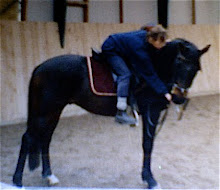
Bent Branderup on Frederiksborg stallion Zarif Lykkesager (picture stolen here - and actually taken in our indoor riding arena)

Saturday, 16 May 2009

Offret

Intro to and clip from Andrei Tarkovsky's Offret - The Sacrifice, one of the most extraordinary films of all times:


Full version of J.S. Bach, Erbarme dich mein Gott (Have mercy, Lord my God), performed by Julia Hamari here.

Hat tip to Abysmal Musings.

Tuesday, 12 May 2009

Thursday, 7 May 2009

Cry for Help - Being a teen is a mental illness

PBS has a documentary on it's site, Cry for Help. Teenage Mental Illness and Suicide, that represents one huge piece of propaganda for NAMI and screening programs like TeenScreen (check out "Recources: Hotlines and Web Sites for Parents") and STEPS (Screening, Treatment, and Education to Promote Strength).

Here are some quotes from the featured story of Stacy Hollingsworth, who today works for NAMI, NJ:

Question: Why did you hide it [her "depression" and suicidal thoughts] from your parents?

Stacy Hollingsworth: I didn't want to hurt them. I knew they would be the type of parents, who would feel they were somehow to blame for my illness. (...)

Q: Were you afraid at all they wouldn't understand?

S.H.: (...) If they did have a negative reaction to it somehow, it was something that I couldn't escape. They would be in my life the whole time.

(From "Stacy", 1. part)

Sharon Hollingworth, Stacy's mother: And then I thought, it was all over, this was the end of all those dreams a parent has for her child. She certainly wasn't going to have the life, that I had hoped and expected her...

(...)

She never really had a chance with us, because we never opened the dialogue. And I guess, she didn't want to disappoint us, or worry us. She was the perfect child.

(From "Stacy", 2. part)

Well well... But no, of course it weren't inhumane expectations to this "perfect child", or the "overachiever", or "All-Star-daughter", as the documentary also describes Stacy, that were causing her trouble at an age, where about everybody, as a quite natural part of their personal development, starts to question among other things society's norms and values of perfection and perfect achievement. Nope. It was a chemical imbalance in the brain, that, as it will seem to me, most if not all teenagers do suffer from. Just as a remarkable number of teenagers suffers from a biological brain disease, that's called "I'm coming from a broken home", "I get bullied", or something else along those lines.

Yes, indeed, the documentary mentions these things. Nevertheless, I got the impression, that being bullied, growing up with violence and abuse (if it is in the shape of parental expectations of perfection, or other) is caused by the victim's defective brain. NAMI's essential message: Depressed? Suicidal? Never ever blame your parents, or society! Blame your brain!

I wonder, why screen at all? Why not straightforward call being a teen a "mental illness", and NAMI-style drug up everybody above age, hm, let's see, 12? 10? or no, wait, it's "early intervention" isn't it? so, 8 maybe? who isn't yet on one or the other or several kinds of mindaltering drugs?

There are numerous options to comment on (and rate) this piece of propaganda at the site. Make use of them, if you feel up to facing tons of NAMI-parents' cheers. Right now, I myself don't.

Monday, 4 May 2009

Check this out, and help if you can!

This actually paralyzed me somewhat yesterday, why I didn't do a post on it. Well, now here it is. Check out the whole story, here and here, and help if you can!

Sunday, 3 May 2009

Random thoughts about being disabled - NOT

A couple of thoughts in the wake of Blogging Against Disablism Day, May 1st, 2009.

1. I haven't been round reading tons of entries on the subject, but a few I have read, and Alison Hymes'Psychophobia 201 was definitely the best I've come across.

2. There's a lot of talk about disability and disablism, also in regard to people with emotional problems. Here for example is a YouTuber, Mary Van Pelt, who does some awesome vids against disablism in work places.

Another aspect is the United Nations' Convention on the Rights of Persons with Disabilities, CRPD, whose wording also was fundamentally influenced by user/ex-user/survivor organizations like MindFreedom.

I very much appreciate the effort both individual persons like Alison Hymes and Mary Van Pelt, and organizations like MindFreedom put into raising awareness about discrimination against and the rights of people in emotional distress. Nevertheless, I have a problem with the overall concept, the overall idea, that people in emotional distress are described as "disabled". Which is that I don't regard emotional distress a disability. Consequently, I myself do not identify as disabled.


While it is true, that I probably would have an extremely hard time coping, get stressed out in no time, and experience emotional trouble, if I had to work under 9 to 5-ordinary job circumstances, I know quite a few "normal" people, who would have just as hard a time, who certainly wouldn't be happy, if they had to make a living under the same circumstances I make mine: working early mornings and late evenings, working weekends and holidays, working outside, regardless the weather, being on "stand-by" 24/7, and handling horses. Does that make these people disabled? If someone ended up with some kind of emotional distress doing the job I do, let's say because they're afraid of or simply don't like horses, is that a disability then?

People often ask me, if my job isn't very hard work, and how I manage doing it without getting run down. Yes, it is hard work. It is physically demanding. On the other hand, it isn't more demanding than being a hunter-gatherer or a pastoral nomad, which is, what human beings are by their very nature. Indeed, I'd say, my job is a lot closer to (human) nature, and a lot less alienating than most of the work situations, modern western civilization expects human beings to cope with. Does it make me disabled, that my human nature rebels against a maybe "normal" but nevertheless unnatural way of living?

Well, of course it makes me disabled in the eyes of an alienated and alienating, and in fact disabled and disabling, culture. While I myself regard it an ability of mine, that my nature is capable of reacting - rebellious - to unnatural demands and situations. And I'd definitely prefer not having to resort to the CRPD, but simply to the Universal Declaration of Human Rights in order to have my human rights respected in any given situation. In my opinion it is a human rights violation in itself, that the latter doesn't protect my human rights in these given situations.

Last but not least, let's face it: which actually does disable the vast majority of people with "psychiatric disabilities" isn't the emotional distress itself. It is the "treatment", the punishment, they receive for rebelling against unnatural, disabling life situations. So, "psychiatric disability" isn't that misleading a term anyway: disabled by psychiatry.

Tuesday, 28 April 2009

Wednesday, 22 April 2009

"Help save Delara from the gallows"

...is the title of this blog post where you can read about Delara Darabi, and about what you can do to prevent her from being executed.

Although neither Amnesty nor other human rights organizations, who aren't by definition specifically concerned with the human rights of psychiatrized people, usually find it necessary to do anything to support our fight against the continued violation of our human rights by the mh system - hint hint! - I find it important to get involved. It only takes a few minutes to make a difference.

Monday, 20 April 2009

A perverted theory, or a perverted culture?

Instead of a comment at Doug Bremner's blog, where I don't want to start anything about this particular issue:

In his latest entry Doug Bremner [writes] wrote:

"There were two psychiatrists there named Fleiss and Lizt who had come up with [perverted] theory years ago that mothers drove their children crazy." (my italics) [Update: Doug Bremner changed his post. Actually before he read this rant. You rock, Doug! :D]

Now, as even I, who is relatively new to Doug Bremner's blog, have realized in the meantime, he lost his mother at the age of four and a half, and, of course, blamed himself for her death: PTSD. - Btw Doug, if you read this: it seems, you forgot to link "here and here and here". Whatever. Which strikes me, is that something so radical and undeniable as the death of one's mother obviously can serve to spare one's acting "artificially" from being labelled as, for instance, "schizophrenic", and thus brain-diseased (???), while less radical, tangible things obviously can't.

Here's some of the radical, undeniable, but nevertheless, compared to a physical death, rather "invisible", truth from my own past:

I cannot recall to have witnessed as much as one single incident of mutual affection between my parents. What I have witnessed, continuously, from day one to the bitter end, was my mother wiping the floor with my father, and, ultimately, since my father made himself scarce, pursuing his career, with me. My mother was the incarnation of suffering and neediness, and, of course, her misery was everybody else's responsibility but her own. With "everybody else" in the absence of my father being me, sure.

There simply was no such thing as unconditional affection - not to mention love - at our house (I can't really make myself call it a "home"). There never was any such thing in my life. And it was my own fault. If you'd asked my mother, that is.

Did I believe that, too? Sure I did. So I started to search for the "magic word", that could break the spell of my mother's misery, and that only I could find. If that makes anyone think of "schizophrenics'" somewhat "different" relationship towards language, words, the "loss of significance", because no word seems to do the trick: right on. While the double bind is just another aspect of the same game. "Find the 'magic word', and free me from my misery, and, no, don't find it, because I am my misery." Fact is, my mother was scared to death of me, because she'd made me responsible for her misery, that is, she'd put me in control of her existence.

Did that drive me crazy?...

Just some random, slightly incoherent - it's still a little touchy - thoughts an early Monday morning. Nothing but a rough outline, a few hints. The "original" consists of a good 250 pages. And yes, the concept of the schizophrenogenic mother is indeed perverted. It wasn't her as an individual. It is our whole perverted culture. Which she, too, was a product of.

Unfortunately for this culture, I wasn't told that it altogether were just meaningless "symptoms" of some obscure and completely meaningless biological brain disease and drugged up over my eyeballs, but guided and supported on my way to becoming conscious of my past. By a therapist, who isn't quite as perverted as our culture as a whole is.

I wonder, what Doug Bremner would have done.
_______________

One more random thought: When I was 29, my mother suffered a stroke during one of our regular arguments. After ten days in a coma, her doctor asked me, if it were all right with me, if they'd pull the plug, which was, what he'd recommend.

I argued with her, and I said "yes".